How CRM Helps Understand Analytical Buyers and Improve Customer Relationships
We’ve already looked at how to avoid losing an impulsive customer for whom speed is everything. Now let’s look at the complete opposite.
This type of customer doesn’t make decisions emotionally, rarely responds to bold marketing claims, and usually won’t buy until they understand how every part of the product works. They care about facts, comparisons, arguments, technical details, and transparent terms.
Above all, they want to feel confident that the company actually understands their needs.
For an English-speaking audience, this customer is best described as an analytical buyer, informed customer, or educated customer. Whatever term you choose, you need to understand that they don’t make decisions under pressure, but only after doing the research.
With this kind of customer, the sales cycle is usually longer. They ask more questions, request documents, compare alternatives, return to earlier agreements, and may revisit the same details several times before making a payment.
But when you handle the process well, these customers often become some of your most loyal. This is because they understand the product and choose it deliberately, making them far more likely to stay with it long term.
With a modern CRM, your company can work with analytical buyers systematically rather than relying on guesswork. CRMs store communication history in one place, record requirements, help analyze customer behavior, suggest the next step for the sales manager, and enable a more personalized customer experience at every interaction.
When AI tools are built into the CRM, the process becomes even more precise. AI can help recognize customer types, extract information from conversations, summarize long message threads, analyze calls, and save important details directly to the deal record.
But before you can tailor your sales approach, you need to recognize this type of customer. Fortunately, analytical buyers often reveal themselves through the questions they ask and the way they communicate.
How to Identify an Analytical Buyer Using AI Customer Segmentation
You can often recognize an analytical buyer during the very first conversation. Rather than emotional reactions, the biggest clues lie in the kinds of questions they ask.
- They Want Specifics – Analytical customers ask for things like technical specifications, detailed pricing, instructions, case studies, technical requirements, implementation examples, contract terms, plan limitations, or exact delivery timelines.
- They Compare Offers – An analytical buyer may say things like, “Your competitor has this feature,” “Why is your price higher?” “What makes your option different?” or “Can you show me where this has already worked?” For them, comparison is a normal part of the buying process, not just a bargaining tactic or objection.
- They Research Your Track Record – Informed customers like to live up to their name. They may read reviews, look through your portfolio, study case studies, ask about similar projects, and check whether your company has experience in their industry.
- They Don’t Like Pressure – With analytical buyers, classic sales triggers such as “This discount ends tonight” or “You need to decide now” can have the opposite effect. They often interpret pressure as a sign that they’re not being given enough space to understand the offer properly.
- They Return to Details – It’s not uncommon for analytical buyers to return a week later with a question like, “You said the integration would take up to 10 days – does that include role configuration or not?” And if the sales manager no longer remembers the context, trust drops quickly.
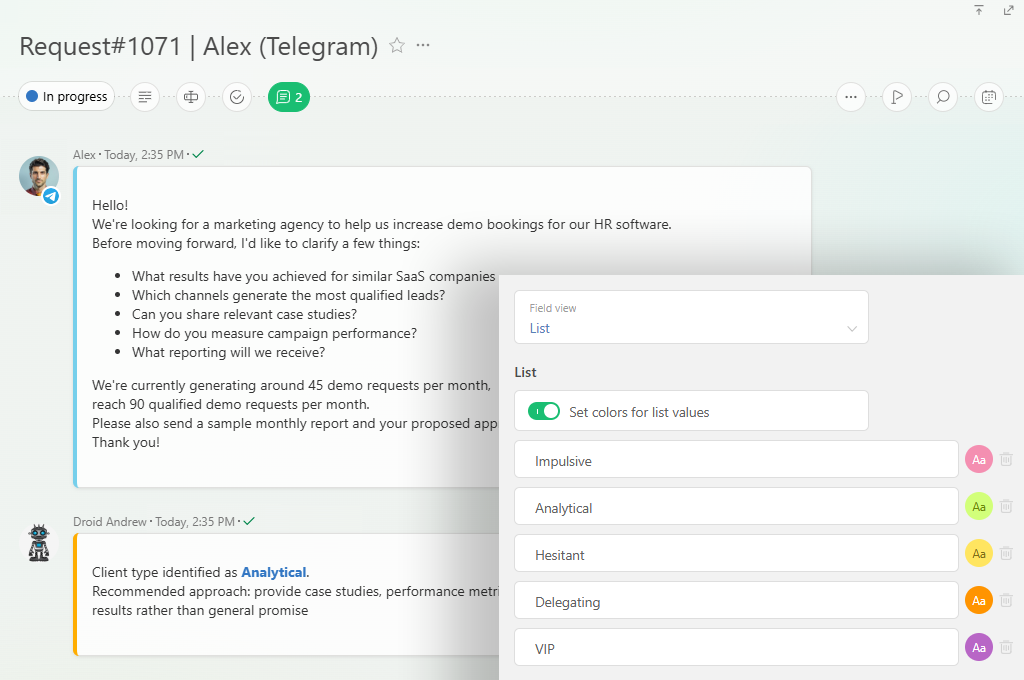
AI customer segmentation is invaluable here, because it can help identify these patterns automatically. Planfix AI excels at this. Once you configure inquiry classification, it can analyze the customer’s first message, recognize characteristic behavioral signals, and assign the inquiry to the appropriate category.
For example, the system may notice that the customer:
- Requests detailed documentation;
- Compares the product with competitors;
- Asks about limitations;
- Clarifies technical specifications;
- Requests case studies or examples;
- Asks a long sequence of related questions;
- Avoids making quick decisions.
From there, the AI can tag the task or deal accordingly, notify the sales manager, and select the right communication scenario to deliver a personalized customer experience. Instead of trying to sell quickly and emotionally, your team can switch to a more structured approach built around facts and evidence.
Customer behavior analysis helps sales managers understand from the very first message that they’re dealing not with an impulsive buyer, but with an informed customer who needs facts, structure, and careful guidance before making a decision.
CRM Tactics for Working with Analytical Buyers
For this type of customer, your company has to understand their needs, remember previous conversations, and avoid pushing them into a quick decision.
This is where CRM becomes especially valuable. Beyond preserving important context, it records requirements, keeps communication history organized, and makes every conversation more specific and relevant.
Here are five practical approaches for working with analytical buyers: qualify the lead correctly, build a detailed customer profile, automate data collection, preserve the full deal context, and analyze the calls that matter most. Let’s explore each of these in more detail.
AI Lead Qualification for Better Sales Decisions
AI lead qualification helps sales teams understand incoming inquiries faster and decide how to properly handle each one.
This is especially valuable with analytical buyers. Their messages can be long and detailed, and their intention to buy is not always stated directly. For instance, a single inquiry can reveal a customer’s budget, deadlines, technical requirements, and concerns, while competitor comparisons and other subtle clues can indicate how close they are to making a decision.
The sales manager needs to quickly understand:
- How ready the customer is to buy;
- Which decision criteria matter most;
- Which objections are already visible;
- What information still needs to be clarified;
- Which communication style will work best;
- Who else should join the conversation;
- What next step to suggest.
Without AI, the manager has to read the message manually, interpret it based on experience, and hope nothing important gets overlooked. With an AI-powered CRM, you can automate a significant part of that initial analysis.
For example, imagine a customer says they are comparing several CRM systems. They state that they want to understand automation limitations, ask for examples from their industry, and request an implementation cost estimate.
To a sales manager, this may simply look like a “complex lead.” But to AI, it clearly signals that the buyer is actively comparing solutions and needs evidence, relevant case studies, technical details, and transparent pricing before moving forward.
Once the lead is qualified, the CRM can help trigger the right sales scenario:
- Avoid sending a short promotional message;
- Don’t push a discount;
- Prepare a detailed response;
- Attach a relevant case study;
- Schedule a consultation with a specialist;
- Save the customer’s decision criteria in dedicated fields;
- Create a follow-up task for a few days later.
This is how CRM sales automation and sales process automation help move the deal forward without rushing the customer. The goal is not speed at any cost, but progress that matches the way the buyer actually makes decisions.
CRM Personalization: Creating a Complete Customer Profile
For an analytical buyer, a standard contact card with a name and phone number is nowhere near enough.
These customers evaluate more than just the product. They also judge the quality of the communication around it. Trust grows when a sales manager remembers previous details, refers back to earlier questions, takes limitations into account, and avoids repeating information the customer has already provided.
If every new conversation starts with “Can you remind me what you needed?”, that trust can disappear quickly.
That’s why your CRM needs to contain more than just basic contact information. It should build a complete customer profile.
In Planfix, you can use additional custom fields such as:
- Decision criteria – Record what matters most to the customer when evaluating a solution;
- Customer pain points – Identify the problems they are trying to solve;
- Key requirements – Specify the conditions the product or service must meet;
- Constraints – Note any budget limits, deadlines, technical limitations, or legal requirements;
- Competitors – List the alternatives the customer is considering;
- Deal risks – Highlight factors that could prevent the purchase;
- Effective arguments – Capture the facts or points that have already resonated with the customer;
- Next step – Define what should happen after the current interaction.
This isn’t paperwork for the sake of paperwork. Instead, it’s customer profiling that gives the sales manager the context needed to deliver a more personalized customer experience and have a more focused conversation.
For example, suppose a customer is choosing a project management system. Their profile shows that flexible access permissions, departmental reporting, and the ability to migrate processes gradually are critical requirements.
On the next call, the sales manager does not need to start over with a generic product presentation. Instead, they can go straight to those specific scenarios.
That is CRM personalization in practice. Instead of following a universal sales script, you build communication around the customer’s real decision criteria.
How CRM Helps Manage Analytical Buyers
| Customer Challenge | CRM Solution | Business Benefit |
| Client needs detailed information | Customer profile management | More relevant communication |
| Long decision process | Saved interaction history | No context loss |
| Multiple requirements | Custom CRM fields | Better personalization |
| Many questions before purchase | AI-powered qualification | Faster sales process |
A strong customer profile helps with much more than closing the initial sale. It also makes deal handoffs easier, improves meeting preparation, gives teams better context for handling objections, and supports more consistent communication after the purchase.
Of course, you can enter this information manually. But in long conversations, important details are easy to miss. A customer may casually mention their budget, timeline, technical requirements, or restrictions somewhere in a comment, email, or task message.
Instead of forcing sales managers to reread the entire conversation and manually copy those details into fields, Planfix AI agents can automate a huge chunk of the data collection process.
AI Dataminer can identify dates, budgets, requirements, and other important details in a conversation and save them to the appropriate fields in the customer or deal record.
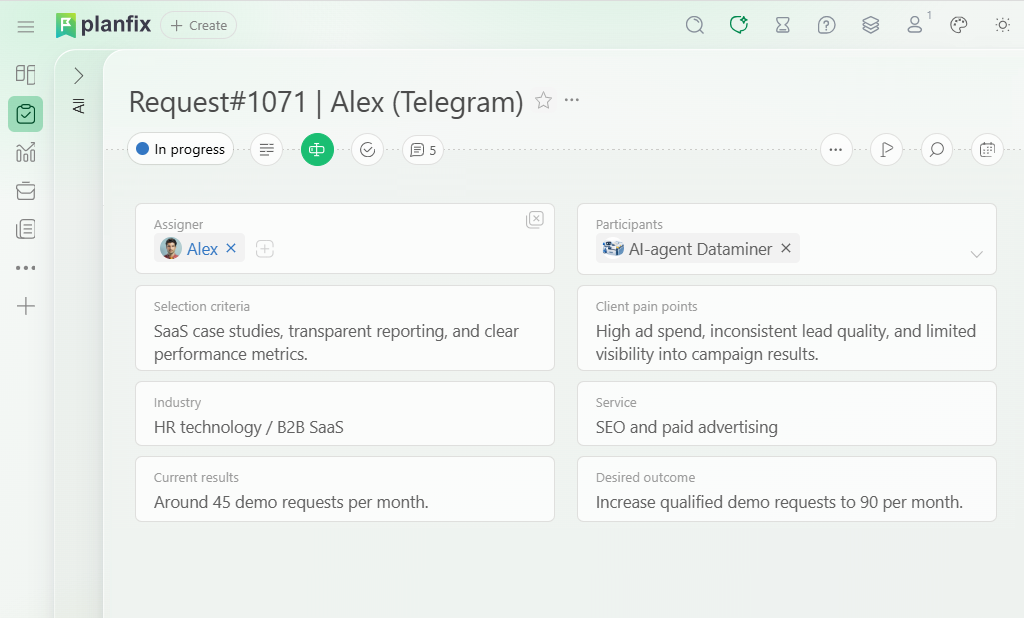
AI Interviewer can collect missing information by running a structured brief directly within the task or deal. It can even ask follow-up questions, organize the answers into the appropriate fields, and notify the sales manager once the required information has been collected.
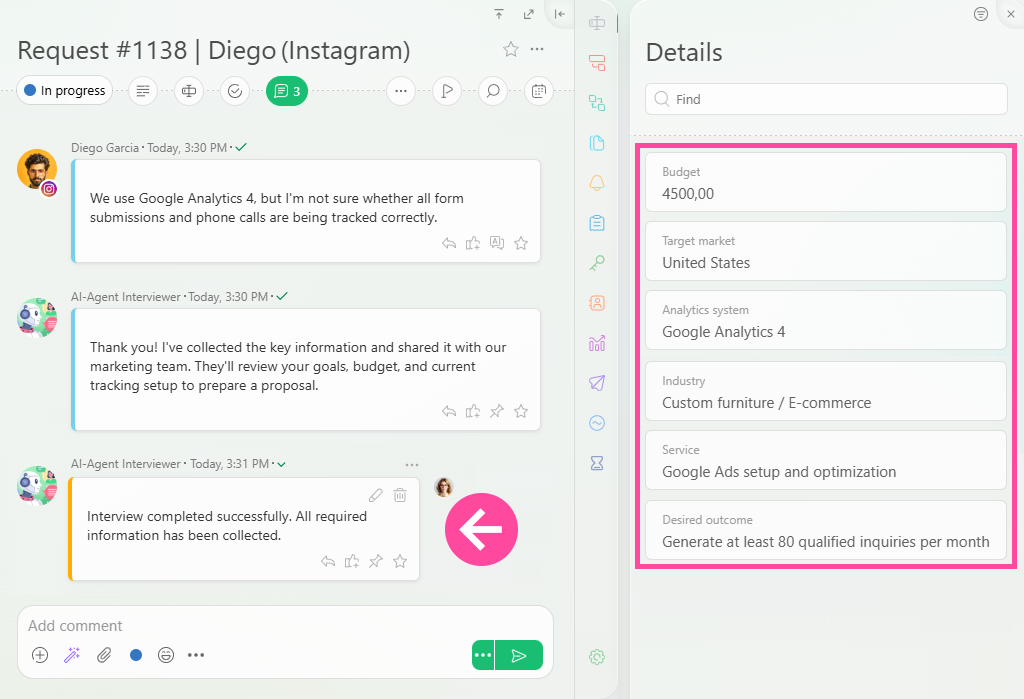
This makes CRM personalization far less dependent on how carefully one employee happens to read every message. Instead, the entire team gets structured customer data they can use for future interactions, consultations, and more relevant sales arguments.
Maintaining Customer Context with CRM Workflow Automation
As we mentioned, analytical buyers remember the details of every conversation. So, if a sales manager forgets what was discussed on the second or third call, asks the customer to resend information, or suggests an option the customer has already rejected, trust can evaporate.
For this type of buyer, context is part of the service.
CRM workflow automation helps preserve that context in the system instead of relying on the manager’s memory. This way, things like message history, calls, files, custom fields, agreements, tasks, and next steps all stay connected to the deal.
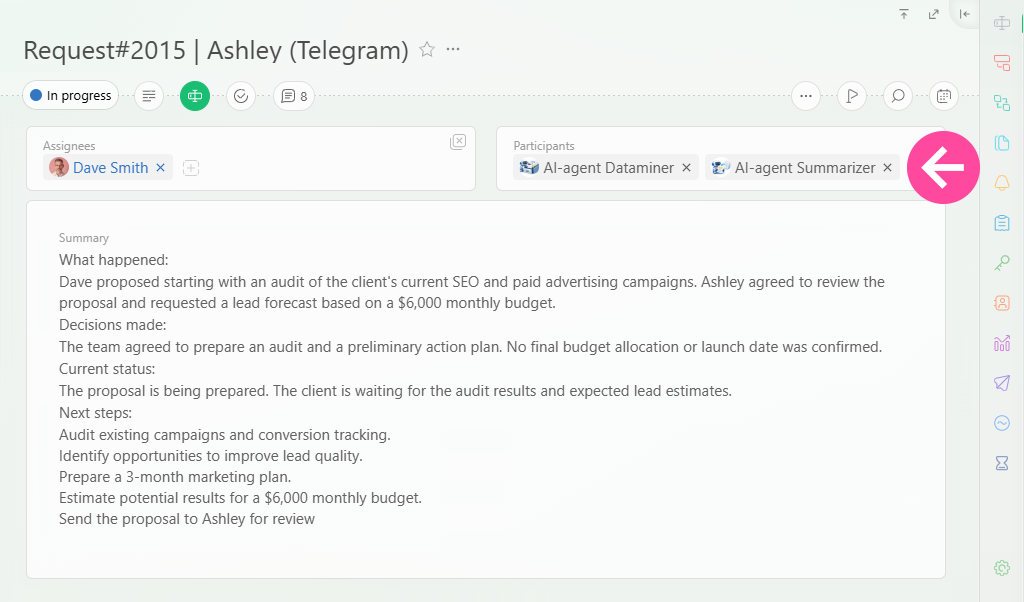
In Planfix, you can preserve customer context at several levels:
- Comments keep the communication history;
- Custom fields store key requirements;
- AI agents extract important facts;
- AI Summarizer maintains a concise overview;
- Tasks and reminders help teams remember the next step;
- Files and documents stay connected to the discussion.
One practical tip for long sales cycles is to create a dedicated field called Current deal status or Key agreements. The Summarizer can even help keep it up to date, while the sales manager can review the latest summary before a call instead of rereading the entire conversation.
This is especially useful when:
- A deal lasts for several months;
- The customer asks many technical questions;
- Several employees are involved in the discussion;
- The deal is handed over to another manager;
- A team lead joins the conversation;
- The full history needs to be restored quickly before a meeting.
The result? The customer can pick up where they left off without repeating their needs or revisiting settled questions. With that context at hand, the sales manager can move the conversation forward and build trust with each interaction.
AI Call Analysis for Understanding Customer Behavior
Analytical buyers often prefer long, detailed calls. They ask follow-up questions, compare options, discuss risks, revisit previous points, and rarely make a final decision immediately after the conversation.
Manually listening to every recording is time-consuming for both the sales manager and the company. But skipping call analysis entirely isn’t a good option either. After all, those conversations tend to reveal the customer’s real motivations.
AI call analysis helps preserve the value of each conversation without forcing someone to replay every recording from start to finish.
In Planfix, this turns a recorded conversation into information your sales team can act on. Planfix AI can transcribe the conversation, highlight key moments, identify customer interest, capture competitor mentions, create data tags, and generate reports.
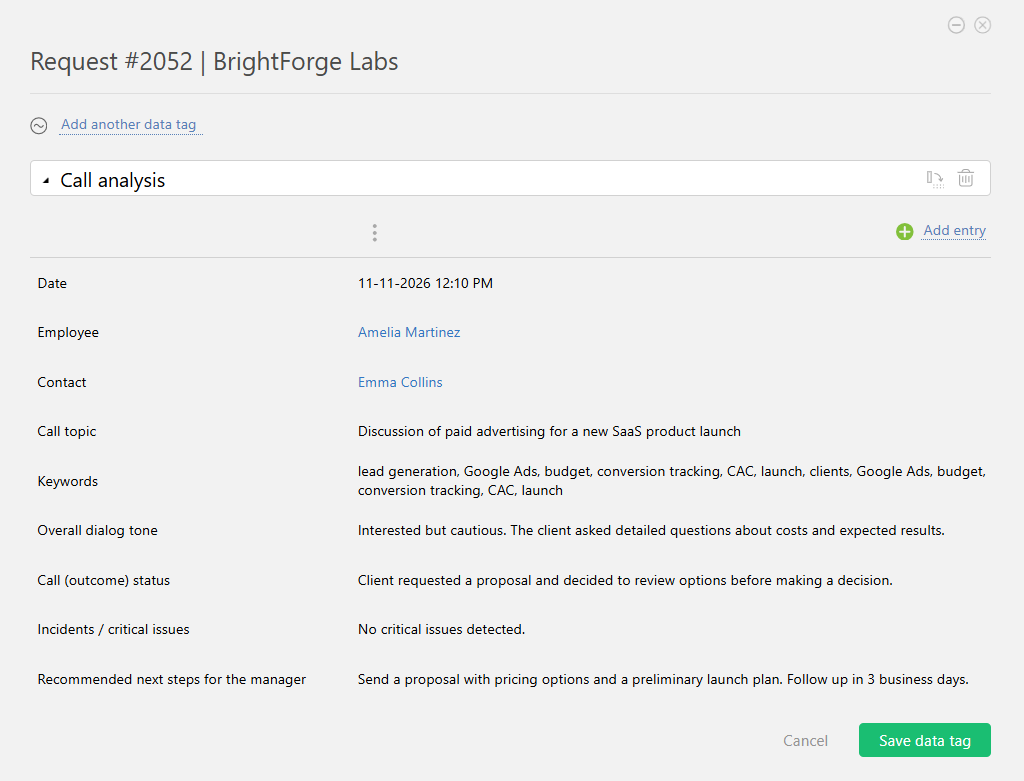
This helps the sales manager immediately understand:
- What the conversation was about;
- Which questions the customer asked most often;
- Which arguments caught their attention;
- Which objections remain unresolved;
- What needs to happen next;
- Which agreements should not be forgotten.
For managers, AI call analysis also works as a quality-control tool, revealing how sales reps handle objections, whether they follow the script, where conversations tend to break down, and which topics appear repeatedly across calls.
Imagine a situation where implementation timelines keep coming up in calls with analytical buyers. Some managers answer confidently, while others only give vague estimates. After reviewing the call analysis, the team lead can spot the inconsistency and update the sales script with a clearer explanation, typical timelines, and the conditions that may affect them.
This is how customer behavior analysis transforms into practical sales and logistics improvement. Rather than just reviewing conversations, the team is able to learn from them and adjust the process as needed.
AI Agents for Customer Data Collection and Sales Automation
Planfix AI agents do more than help sales managers respond faster. From the first customer message onward, they can collect information, preserve context, analyze calls, and help managers determine the next step in the sales process.
- AI Dataminer helps prevent important details from getting lost in conversations. It can automatically turn requirements, deadlines, budgets, order parameters, and other critical facts into structured deal data.
- AI Interviewer is especially useful when you need more information from the customer. It can collect missing details without a long back-and-forth conversation and give the sales manager a more complete picture of the request.
- AI Summarizer helps restore the context of a long-running deal in seconds. Instead of reading dozens of comments, the manager gets a concise overview of what was discussed, what was agreed on, and which questions are still open.
- AI Call Analyst extracts useful information from long conversations. It can highlight key topics, agreements, objections, customer interests, and next steps without requiring the manager to listen to the entire recording.
- AI Comment Assistant helps sales managers prepare clearer, more polished responses. It can adjust the tone, shorten a message, improve clarity, or adapt the wording to a specific situation.
- AI Translator makes it easier to communicate with customers in different languages without switching to external tools. This helps teams maintain both response speed and a consistent communication style.
- AI Knowledge Base helps find relevant information in approved company materials and prepare responses based on internal sources such as instructions, pricing plans, policies, catalogs, and procedures.
- AI-Powered Task Clarity helps check whether a task contains enough information to move forward. It looks for indicators that the expected result is clear, deadlines are included, responsibility is assigned, and the next step has not been missed.
Together, these tools work as one comprehensive AI sales assistant. They reduce routine work, help managers understand customers more clearly, and make the sales process easier to manage from one stage to the next.
Benefits of AI-Powered CRM for Analytical Buyers
Working with analytical buyers takes patience, precision, and a good memory. An AI-powered CRM helps keep that process structured and under control while offering a number of strategic benefits.
More Personalized Communication
The CRM stores the customer’s decision criteria, pain points, requirements, and interaction history. Instead of relying on a generic script, the sales manager can shape each response around what actually matters to that specific buyer, creating a more personalized customer experience.
Faster Lead Qualification
AI helps analyze the first inquiry, identify the customer type, highlight important signals, and suggest the most appropriate communication strategy.
Less Manual Work
AI agents can extract information from conversations, conduct structured interviews, summarize long discussions, and reduce the time managers spend copying details from messages into CRM fields.
Better Context Retention
With an AI-powered CRM, long sales cycles don’t have to break into disconnected conversations. Communication history, agreements, files, calls, and next steps remain connected inside the platform.
Greater Customer Trust
When a company remembers all the details, responds with relevant evidence, and avoids unnecessary pressure, analytical buyers have more confidence in the sales process.
Better Visibility for Managers
AI can help analyze calls and conversations, identify recurring questions, reveal weak points in communication, and give managers better information for coaching their sales team.
Final Thoughts
The key is not to push analytical buyers to move faster than they’re ready to. With these types of buyers, the right approach is one that includes less pressure, more evidence, consistent follow-up, careful context management, and arguments tailored to their real priorities.
Planfix helps you build exactly that kind of process, from identifying the customer type to capturing structured data, maintaining a deal summary, analyzing calls, and giving the sales manager a clear next step.
FAQ
What is an analytical buyer?
An analytical buyer is a customer who makes decisions based on facts, details, comparisons, and proof rather than emotions or urgency. They usually ask for specifications, pricing details, case studies, implementation examples, and clear explanations. Their buying cycle is often longer, but once they understand the value of a product, they can become highly loyal customers.
How can CRM help understand customer behavior?
CRM helps understand customer behavior by collecting communication history, requirements, questions, objections, files, calls, tasks, and deal progress in one place. When this data is structured, teams can see what the customer cares about, which concerns repeat, what slows down the deal, and which next step is most relevant for a specific buyer.
How does AI improve lead qualification?
AI improves lead qualification by analyzing the first customer messages and identifying important signals, including intent, urgency, needs, budget, product interest, objections, and readiness to buy. This helps sales teams choose the right communication strategy faster. For analytical buyers, AI can also detect requests for detailed information, comparisons, technical requirements, or case studies.
What is customer profiling in CRM?
Customer profiling in CRM means building a structured profile that includes more than basic contact details. It can include needs, decision criteria, pain points, budget, objections, preferred communication style, previous interactions, documents, and deal history. A strong customer profile helps sales teams personalize communication and avoid asking the same questions again.
How does AI help personalize customer communication?
AI helps personalize customer communication by analyzing previous messages, extracting important details, summarizing context, and suggesting replies based on the customer’s actual needs. Instead of sending the same generic response to everyone, managers can prepare answers that reflect the client’s requirements, concerns, and stage in the buying journey while still keeping human control over the final message.
