How to Create a Successful CRM Strategy: Easy Steps

A CRM strategy defines exactly who owns each lead, how fast the team responds, when follow-ups happen, and how results are measured. It is not the software — it is the rules that make the software useful. Companies that build a clear CRM strategy close more deals, lose fewer customers, and stop depending on individual habits to keep relationships alive. The strategy covers seven areas: business goals, customer journey, data organization, segmentation, communication standards, repeatable workflows, and performance metrics.
Many businesses invest in CRM software before defining how customer relationships should be managed. The result is usually the same: customer information becomes scattered, follow-ups are missed, and teams work according to personal habits rather than a shared process. A successful customer relationship management strategy solves this problem by creating clear rules that everyone follows.
Whether the goal is increasing sales, improving retention, reducing response times, or delivering better customer service, the CRM strategy provides the structure that turns customer interactions into measurable business outcomes.
What Is a CRM Strategy?
A CRM strategy is a structured plan that defines how a company acquires, manages, serves, and retains customers. It explains how customer information is collected, how leads are processed, how teams communicate with customers, and how success is measured throughout the customer lifecycle.
Many businesses confuse CRM software with CRM strategy. Software provides the tools. Strategy defines how those tools should be used to achieve business goals.
For example, a company may use CRM software to store customer records, track opportunities, and manage communication. However, the software itself does not determine who owns a lead, when a follow-up should occur, or which metrics indicate success.
A strong customer relationship management strategy usually includes:
- Business goals are connected to customer management.
- The customer journey is documented.
- Customer information is centralized.
- Customers are segmented by useful criteria.
- Communication standards are defined.
- Workflows are repeatable.
- CRM performance is measured regularly.
These elements create a system that helps teams manage customer relationships predictably instead of relying on memory, spreadsheets, or personal notes.
Before building workflows or selecting CRM software, companies should first decide which business outcomes they want to improve. Clear goals provide direction for every process, workflow, and metric that follows.
CRM Strategy vs CRM Software
The difference between CRM strategy and CRM software is simple: strategy defines the process, while software supports the process.
Without a strategy, even the most advanced CRM platform becomes a storage location for customer data. Employees may enter information, but they do not necessarily follow the same workflow or pursue the same business goals.
A CRM strategy answers practical questions:
- Who owns each lead?
- How quickly should new inquiries receive a response?
- When should follow-ups occur?
- What information must be recorded?
- Which metrics should managers monitor?
The software helps execute those decisions, but it cannot create them.
Why Every Customer Relationship Management Strategy Needs Clear Goals
Every customer relationship management strategy should begin with business goals. Companies that implement CRM processes without defining objectives often collect large amounts of data without improving business performance.
The purpose of CRM is not simply to organize customer information. The purpose is to improve measurable outcomes.
Common CRM goals include:
- increasing lead conversion rates;
- improving customer retention;
- reducing missed follow-ups;
- shortening the sales cycle;
- increasing customer lifetime value;
- improving customer satisfaction;
- making sales forecasting more accurate.
Each goal should be measurable. For example, “improve customer relationships” is difficult to evaluate. “Increase retention from 78% to 85%” or “reduce lead response time to under one hour” gives the team a clear target.
These goals influence every part of the CRM strategy. They determine which workflows should exist, what information should be collected, which automations are needed, and how performance should be measured.
Before configuring any CRM system, businesses should identify where leads are being lost, why customers stop buying, which customer segments generate the most revenue, and which processes depend too heavily on individual employees.
When CRM goals align with business objectives, the strategy becomes a growth tool rather than an administrative system.
Easy Steps to Create a Strategy for CRM
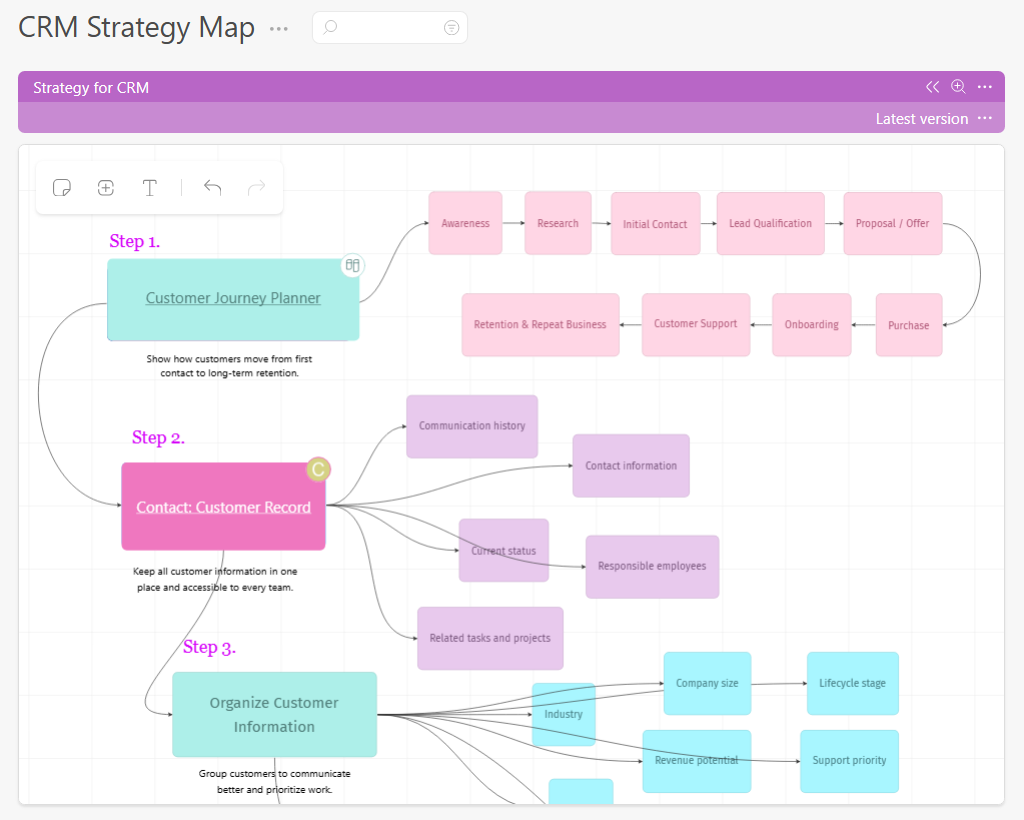
The best strategy for CRM is straightforward enough for employees to follow every day. Businesses often make the mistake of building complex automation before defining basic customer processes.
The following framework works for most organizations because it starts with customer behavior and then builds workflows around it.
Step 1. Map the Customer Journey
The customer journey describes how people interact with your business from first contact through long-term retention.
Mapping this journey helps identify delays, communication gaps, weak handoffs, and stages where customers frequently leave the process.
A typical customer journey includes:
- Awareness.
- Research.
- Initial contact.
- Lead qualification.
- Proposal or offer.
- Purchase.
- Onboarding.
- Customer support.
- Retention and repeat business.
Once these stages are documented, businesses can assign ownership and define what should happen at each point.
This is where task management becomes valuable because every customer stage should generate a clear next action for a responsible employee.
The customer journey becomes the foundation for the entire CRM strategy.
Step 2. Organize Customer Information
Customer information should be stored in one place and remain accessible to every team that interacts with customers.
Many businesses struggle because customer information exists across emails, spreadsheets, chat applications, and personal notes. This creates confusion and makes it difficult to understand the full customer relationship.
A useful customer record should include:
- contact information;
- communication history;
- current status;
- responsible employees;
- related tasks and projects.
In Planfix, contacts provide a centralized customer database that connects customer records with tasks, files, communication, and workflows.
Centralized information improves visibility and helps different departments work from the same customer context.
Step 3. Segment Your Customers
Customer segmentation helps businesses communicate more effectively and allocate resources more efficiently.
Not every customer requires the same sales process, service level, or communication style.
Common segmentation criteria include:
- industry;
- company size;
- location;
- revenue potential;
- purchase history;
- lifecycle stage;
- support priority.
Segmentation allows businesses to prioritize their efforts and create more relevant customer experiences.
For example, a high-value enterprise lead may require immediate personal follow-up, while smaller inbound requests may follow a more automated workflow.
The objective is not to create dozens of customer groups. The objective is to create segments that help the team make better decisions.
Step 4. Standardize Communication
Communication standards define how the company interacts with customers.
Without clear communication rules, response times vary, follow-ups are missed, and customers receive inconsistent experiences.
A simple communication framework may include:
- New leads receive a response within 2 hours.
- Follow-up calls occur within 24 hours after a proposal.
- Customer requests are assigned immediately.
- Important conversations are recorded in the customer record.
- Unresolved issues are reviewed weekly.
These standards help teams provide a more reliable customer experience.
Planfix helps businesses manage customer communications across multiple channels while keeping every interaction connected to the appropriate customer record.
After communication standards are established, customer interactions become easier to manage and measure.
Step 5. Build Repeatable Workflows
A CRM strategy becomes valuable when it turns into daily workflow.
Employees should know exactly what happens when:
- a new lead arrives;
- a deal changes status;
- a customer submits a request;
- a follow-up becomes overdue;
- a customer issue requires escalation.
Documented workflows reduce uncertainty and improve accountability.
They also make onboarding easier because new employees can follow an established process rather than learning through trial and error.
A workflow does not need to be complex. It needs to be visible, understandable, and followed by the team.
Step 6. Measure Results
CRM performance should be measured continuously. Data helps businesses identify weaknesses and improve processes over time.
Useful CRM metrics include:
| Metric | Why It Matters | Healthy Benchmark |
| Lead conversion rate | Measures sales effectiveness. | 2–5% for B2B outbound. |
| Average response time | Shows responsiveness. | Under 1 hour for inbound leads. |
| Customer retention rate | Indicates customer loyalty. | 85%+ is considered strong. |
| Sales cycle length | Measures process efficiency. | Should decrease over time. |
| Repeat purchase rate | Shows customer engagement. | Consistent growth is expected. |
| Customer satisfaction score | Measures customer experience. | 80%+ positive responses. |
| Missed follow-ups | Shows process breakdowns. | Should trend toward zero. |
Benchmarks provide context. A metric by itself may not indicate whether performance is strong or weak.
Once these indicators are tracked regularly, businesses can identify opportunities to improve workflows, communication, onboarding, and customer service.
Types of CRM Strategies
The three main types of CRM strategies are:
- Operational CRM — focuses on lead assignment, follow-ups, sales pipelines, and support workflows.
- Analytical CRM — focuses on customer data, reporting, forecasting, and business insights.
- Collaborative CRM — focuses on sharing customer information across departments.
Most businesses start with operational CRM because it produces immediate improvements in lead management and follow-up control. As customer data grows, analytical CRM helps identify trends, customer behavior patterns, and growth opportunities. Collaborative CRM becomes increasingly important when multiple departments interact with the same customers throughout the lifecycle.
Strategies for Customer Relationship Management That Improve Retention and Sales
The best strategies for customer relationship management improve two outcomes: more customers convert and more customers stay. While every business has different goals, the strongest CRM strategies help teams respond faster, communicate with more context, and build stronger long-term relationships.
Before implementing automation or dashboards, companies should identify which customer behavior they want to improve. Some organizations need better lead conversion. Others need stronger retention, faster support, or more repeat purchases.
The following strategies consistently produce results across industries.
Lead Management Strategy
A lead management strategy defines how new inquiries enter the business, who owns them, and how quickly they receive attention.
Without a structured process, even qualified leads can be lost because nobody knows what should happen next.
An effective lead management process should include:
- Lead capture rules.
- Automatic lead assignment.
- Qualification criteria.
- Response-time standards.
- Follow-up schedules.
- Deal stage definitions.
- Escalation procedures.
These rules create accountability and help managers identify where opportunities are being lost.
Companies often see immediate improvements after implementing lead management because fewer inquiries go unanswered and follow-up becomes easier to control.
Customer Retention Strategy
Customer retention is usually more profitable than customer acquisition. Winning a new customer often costs significantly more than keeping an existing one.
A retention-focused CRM strategy should define how the company stays connected with customers after the initial sale.
Common retention activities include:
- onboarding programs;
- customer success check-ins;
- renewal reminders;
- satisfaction surveys;
- proactive support outreach;
- reactivation campaigns.
These activities help identify potential issues before customers decide to leave.
Retention strategies work best when customer history, previous purchases, support requests, and communication records are visible to the team.
Customer Support Strategy
Customer support has a direct impact on retention, customer satisfaction, and referrals.
Many businesses separate support from CRM, but customers experience both as part of the same relationship.
A support-focused CRM strategy should define:
- How requests are received.
- Who owns each request.
- How quickly the first response occurs.
- Which issues require escalation.
- How resolution quality is measured.
Planfix provides dedicated workflows for a support team, helping businesses connect customer requests with communication history, tasks, and responsible employees.
When support information becomes part of the CRM process, managers gain a more complete understanding of the customer experience.
Sales Process Strategy
A sales process strategy defines how opportunities move from first contact to closed deal.
Without clear stages, sales pipelines become difficult to manage and forecasting becomes unreliable.
A sales strategy should define:
- qualification requirements;
- pipeline stages;
- proposal processes;
- approval rules;
- follow-up expectations;
- reporting requirements.
For companies that manage orders, deliveries, or customer transactions, sales & logistics workflows can connect sales activity with operational execution.
This helps ensure that customer expectations remain aligned with delivery capabilities.
Examples of Customer Relationship Management Strategies
Examples of customer relationship management strategies show how CRM principles work in real business situations.
A useful example should describe the process, the rules, and the expected result.
Example of CRM Strategy for a B2B Services Company
A B2B services company received leads from referrals, website forms, and outbound sales. Before creating a CRM strategy, each manager handled leads differently. Some leads received fast responses, others waited several days, and customer history was scattered across email and spreadsheets.
The company created a real-world CRM workflow:
- Every new lead was assigned to a manager within 15 minutes.
- A first response was sent within 2 hours.
- A follow-up call was scheduled within 24 hours.
- All communication was saved in the customer record.
- Proposals automatically created follow-up tasks.
- Lost deals were reviewed every month.
This example of CRM strategy improved accountability. Managers could see who owned each lead, what the next action was, and where deals were being lost.
Example of CRM Strategy for an Online Store
An online store may use CRM strategy to increase repeat purchases and reduce customer churn. Instead of focusing on long sales negotiations, the store usually works with purchase history, customer segments, delivery issues, and post-purchase communication.
A simple online store CRM strategy may include:
- Customers are segmented by purchase history and average order value.
- Post-purchase messages are sent after delivery.
- Support requests about delivery or returns are linked to the customer record.
- Inactive customers receive reactivation offers after 60–90 days.
- Repeat purchase rate and customer satisfaction are reviewed monthly.
This example is useful because it shows that CRM strategy is not only for B2B sales teams. Any company that works with repeat customers can use CRM rules to improve retention and customer experience.
Example of CRM Strategy for an SMB
An SMB usually needs a CRM strategy that is simple, clear, and easy to maintain.
A useful SMB CRM strategy may include:
- One customer database.
- Clear lead ownership.
- Follow-up reminders.
- Weekly pipeline review.
- Basic retention tracking.
The goal is not to automate everything. The goal is to make sure every customer interaction is visible and actionable.
Even a simple CRM process can significantly improve sales visibility and customer management.
How to Implement a CRM Strategy in Planfix
Planfix helps businesses turn CRM strategy into daily operations by connecting customer records, tasks, communication, workflows, projects, and reporting in one system.
Instead of managing customer relationships across several disconnected tools, teams can work from a shared environment where every interaction is visible.
Create a Centralized Customer Database
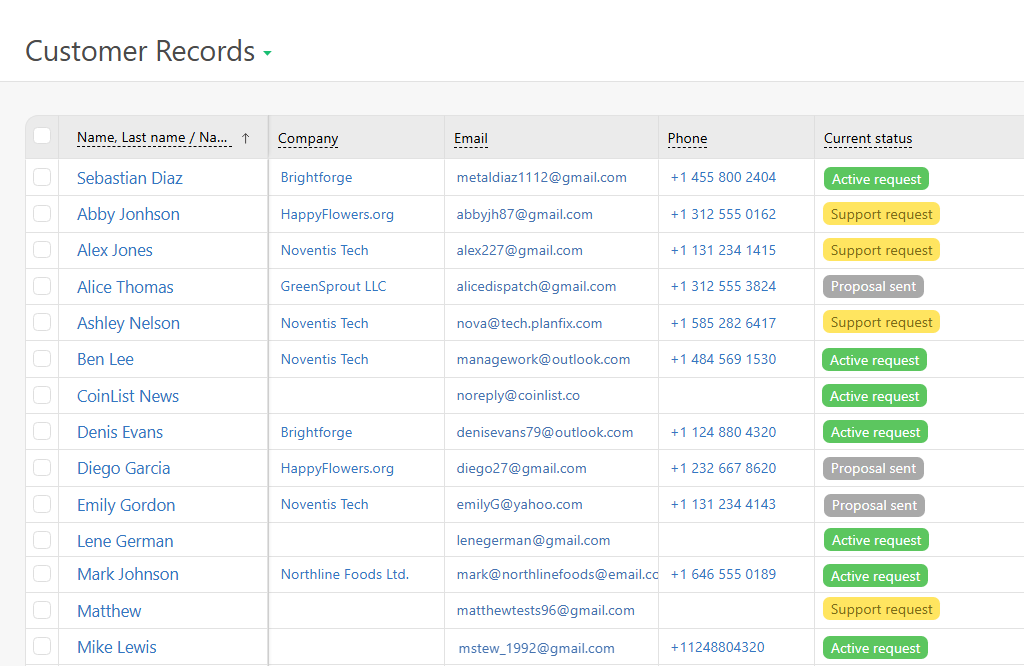
The first step is creating a structured customer database.
Using contacts, businesses can maintain customer records that include communication history, responsible employees, related tasks, files, and current status.
A centralized customer database gives every department access to the same information.
When a customer contacts support, employees can immediately see previous conversations, open tasks, and active projects.
This reduces duplicated work and improves service quality.
Turn Customer Actions Into Tasks
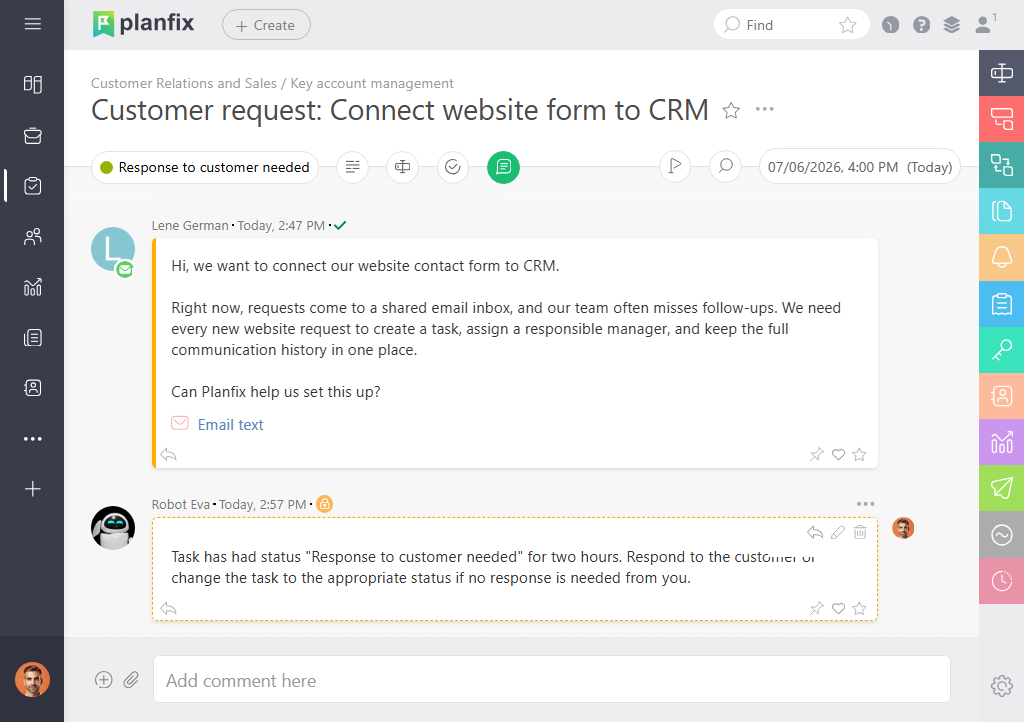
A CRM strategy becomes effective when customer actions create clear responsibilities.
If a lead needs a call, a task should exist. If a proposal requires approval, a task should exist. If a customer issue needs resolution, a task should exist.
Planfix allows teams to manage customer-related task records with deadlines, assignees, statuses, reminders, and customer context.
This helps answer critical questions:
- Who owns the customer?
- What should happen next?
- When is the deadline?
- Is any action overdue?
When these answers are visible, CRM becomes part of daily work rather than a separate administrative system.
Build Sales and Support Workflows
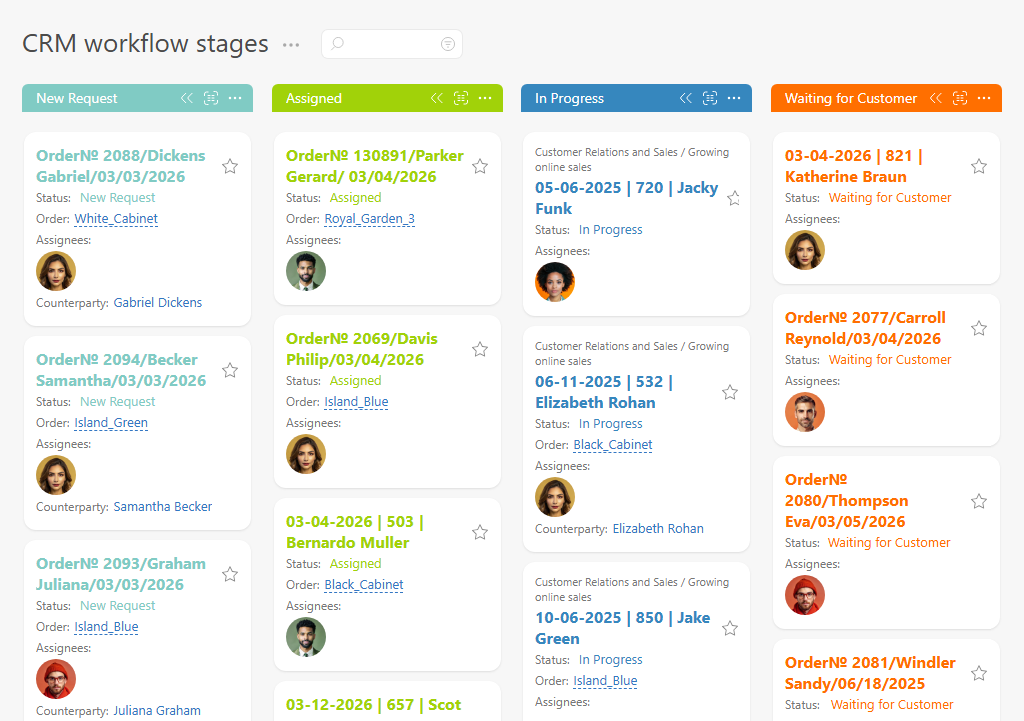
CRM workflows should reflect how the company actually works.
A sales workflow may include:
- New Lead.
- Qualification.
- Proposal.
- Negotiation.
- Approval.
- Won Customer.
A support workflow may include:
- New Request.
- Assigned.
- In Progress.
- Waiting for Customer.
- Resolved.
- Closed.
These workflows help teams standardize actions, reduce delays, and improve accountability.
Planfix can connect customer records, statuses, tasks, and communication into a single workflow that managers can monitor in real time.
Use Projects for Complex Customer Work
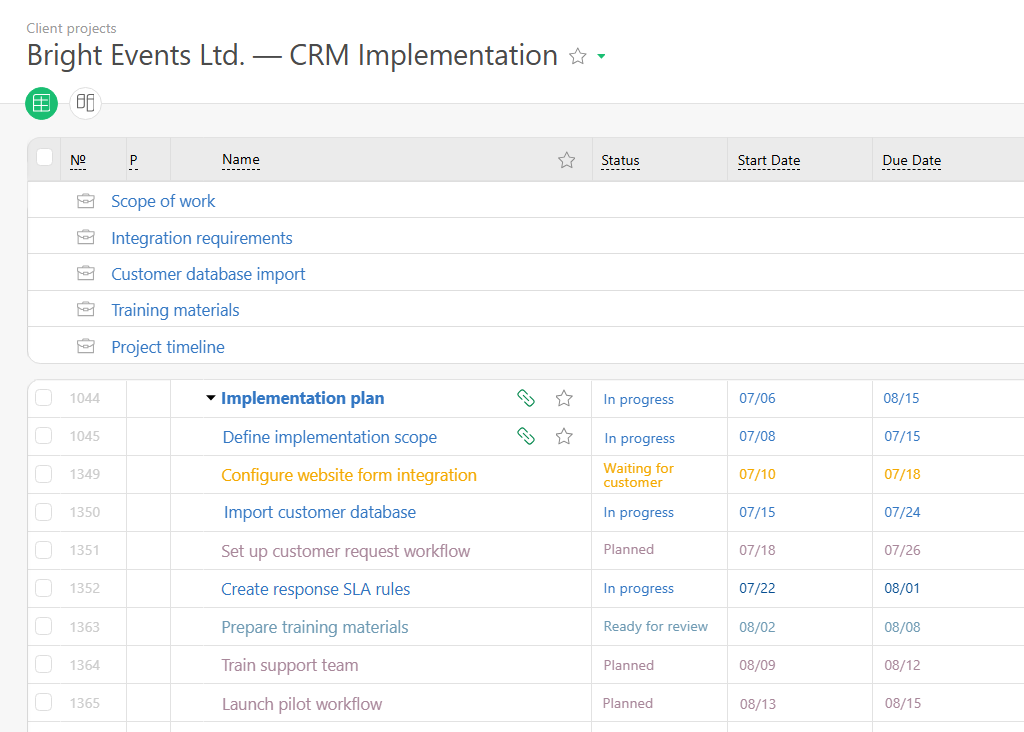
Some customer relationships continue long after the sale.
Consulting engagements, software implementation projects, service contracts, and ongoing partnerships require structured coordination.
Planfix combines CRM with project management, allowing businesses to connect customer relationships with project execution.
This helps teams manage deadlines, participants, tasks, files, and progress in one place.
When CRM and project management work together, businesses gain a more complete view of customer relationships.
Measure CRM Results With Reports
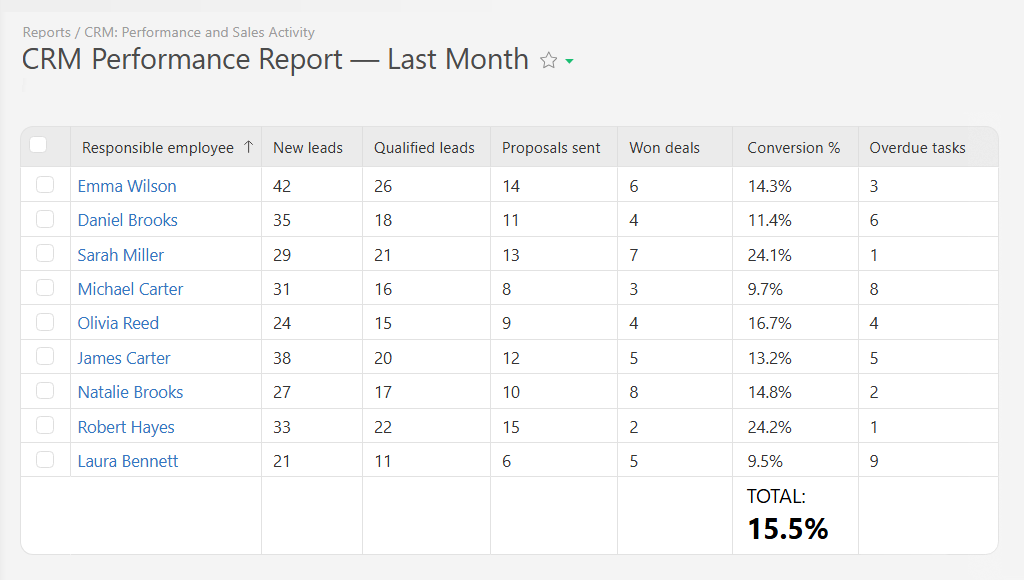
A CRM strategy should be evaluated continuously.
Planfix provides detailed reports that help managers track:
- Lead conversion rates.
- Response times.
- Customer retention.
- Team workload.
- Overdue tasks.
- Sales activity.
Reports help managers identify bottlenecks and improve workflows.
For example, if many deals stall after proposals are sent, follow-up procedures may need improvement. If support requests remain unresolved too long, escalation rules may need adjustment.
Reporting transforms CRM from a static system into a continuous improvement process.
Align Teams Around Shared Customer Data
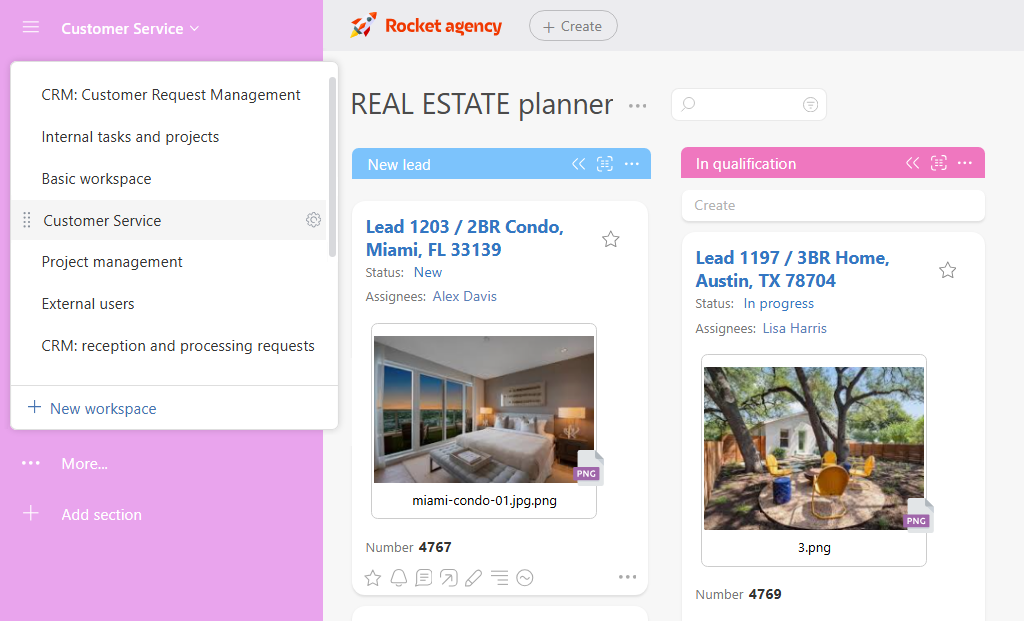
Successful CRM strategies require multiple departments to work from the same information.
Planfix supports cross-functional collaboration through teamwork management and a shared workspace where sales, support, operations, and management teams can access customer context, tasks, communication history, and project status.
This reduces information silos and helps customers receive a more consistent experience regardless of which team they contact.
Common CRM Strategy Mistakes
Many CRM initiatives fail because businesses focus on technology before process.
The software may be implemented successfully, but employees continue working as they always have.
Common CRM mistakes include:
- Buying software before defining business goals.
- Collecting customer data without maintaining data quality.
- Creating workflows that are too complex.
- Failing to assign ownership clearly.
- Ignoring customer segmentation.
- Measuring activity instead of outcomes.
These mistakes reduce adoption and make CRM systems harder to maintain.
How to Avoid These Mistakes
The safest approach is to start simple.
Companies should:
- define goals before configuring the system;
- document the customer journey;
- create simple workflows first;
- train employees on the process;
- review CRM data regularly;
- improve workflows gradually.
After the first version is running, review CRM data every month: check overdue follow-ups, inactive customers, unresolved support requests, and deal stages where opportunities are most often lost. These reviews show which part of the strategy should be adjusted next.
Conclusion
A successful CRM strategy is not defined by the software a company uses. It is defined by clear ownership, standardized communication, measurable goals, and repeatable workflows that help teams manage customer relationships more effectively.
The strongest strategies for customer relationship management connect customer data, tasks, communication, reporting, and team responsibilities into one straightforward process. This helps companies reduce missed actions, improve service quality, and make customer work more predictable.
Planfix helps businesses put these principles into daily work by connecting customer records, tasks, communication, workflows, projects, and reports in one system. Companies that consistently apply these principles typically see improvements in lead conversion, retention, and customer satisfaction within the first two quarters of implementation.
FAQ
What is CRM strategy?
CRM strategy is a structured plan that defines how a company manages leads, customer data, communication, sales processes, support activities, retention efforts, and performance measurement throughout the customer lifecycle.
What is an example of CRM strategy?
A practical example: a B2B services company sets a rule that every new lead is assigned to a manager within 15 minutes, a first response is sent within 2 hours, a follow-up call is scheduled within 24 hours, all communication is logged in the customer record, and lost deals are reviewed monthly to identify patterns. This single workflow can reduce missed leads by 30–40% in the first quarter.
What are the main types of CRM strategies?
The three main types of CRM strategies are operational CRM, analytical CRM, and collaborative CRM. Operational CRM focuses on workflows, analytical CRM focuses on customer insights, and collaborative CRM focuses on sharing information across teams.
How do you create a customer relationship management strategy?
To create a customer relationship management strategy, define business goals, map the customer journey, organize customer data, segment customers, standardize communication, build workflows, and track performance metrics.
Why is CRM strategy important?
CRM strategy helps businesses manage customer relationships in the same way across the team. It reduces missed follow-ups, improves customer experience, increases visibility, and supports better decision-making.
What metrics should a CRM strategy track?
A CRM strategy should track lead conversion rate, response time, customer retention, sales cycle length, customer satisfaction, repeat purchases, and overdue customer actions.
