

The competitive e-commerce landscape, delivering personalized customer experiences, has become essential rather than optional. This shift has accelerated the adoption of Customer Relationship Management (CRM) systems in online retail. CRM in e commerce has evolved from simple contact management to become the central nervous system of successful e-commerce operations.
Modern consumers expect seamless experiences, personalized recommendations, and instant support across all touchpoints. To meet these expectations, e-commerce businesses need integrated systems that connect customer data, purchase history, and support interactions. Tools like Planfix help streamline these processes without requiring extensive technical expertise.
As competition intensifies and acquisition costs rise, the strategic focus has shifted from simply acquiring new customers to nurturing existing relationships and maximizing lifetime value. This makes e commerce and CRM integration not just a technical consideration but a fundamental ecommerce CRM strategy for brands of all sizes.
What Is CRM Integration in eCommerce?
CRM integration with ecommerce refers to the process of connecting your customer relationship management system with your online store platform to create a synchronized ecosystem where data flows seamlessly between systems. This connection eliminates silos between your sales, marketing, and customer service departments by centralizing customer information and interactions.
When properly implemented, e-commerce CRM integration establishes a two-way street of information between your e-commerce platform and your customer management system. This means when a customer places an order on your website, their information and purchase details automatically populate in your CRM. Similarly, when customer data is updated in your CRM — perhaps after a support interaction — those changes can reflect across your e-commerce ecosystem.
The types of data typically synchronized through CRM integration with e-commerce include:
- Customer profile information (name, contact details, shipping addresses).
- Order history and purchase patterns.
- Shopping cart activities, including abandoned carts.
- Support tickets and interaction history.
- Marketing campaign engagement (email opens, clicks, responses).
- Product browsing behavior and wishlist items.
- Loyalty program status and rewards.
These integrations work with virtually all major e-commerce platforms, including:
- Shopify and Shopify Plus;
- WooCommerce for WordPress;
- Magento (Adobe Commerce);
- BigCommerce;
- PrestaShop;
- Custom-built e-commerce solutions.
The technical methods for achieving this integration vary based on your specific setup, ranging from native integrations (plugins or extensions provided by your CRM or e-commerce platform), API connections (custom data bridges built by developers), or middleware solutions (third-party tools like Zapier that connect applications).
Why Integrate CRM with Your eCommerce Business?
Integrating a CRM system isn’t just a technical upgrade — it’s a business growth strategy. In the competitive world of online retail, the difference between thriving and merely surviving often comes down to how effectively you manage customer relationships. CRM and ecommerce integration provides the infrastructure needed to execute personalized, data-driven strategies at scale.
Centralized Customer Data
The foundation of effective customer relationship management is having a complete view of each customer. CRM integration with e-commerce creates a single source of truth for customer data, eliminating the fragmentation that occurs when information is scattered across multiple platforms. This 360-degree view includes not just basic contact information, but purchase history, support interactions, marketing engagement, and even browsing behavior.
This centralization allows any team member, whether in sales, support, or marketing, to access the same comprehensive customer profile. When a customer reaches out with a question, your support team can immediately see their purchase history, previous interactions, and preferences without asking the customer to repeat information they’ve already provided elsewhere.
Personalized Marketing Campaigns
With integrated customer data, your marketing efforts can transition from generic blasts to hyper-personalized communications. Your CRM can segment customers based on purchase history, browsing behavior, average order value, and dozens of other factors. This segmentation enables targeted campaigns that speak directly to each customer’s unique interests and needs.
For example, you can automatically trigger an email offering accessories to customers who recently purchased a specific product, or send special promotions to customers who haven’t purchased in the last six months. This level of personalization significantly improves conversion rates compared to one-size-fits-all approaches.
Better Customer Service and Support
When your support team has immediate access to a customer’s complete order history and previous interactions, they can provide faster, more personalized assistance. Instead of asking customers to provide order numbers or explain their issue from scratch, agents can focus on solving problems quickly.
An integrated CRM also allows support teams to log detailed notes about each interaction, ensuring that customers don’t have to repeat themselves when reaching out through different channels or speaking with different team members. This continuity creates a more satisfying support experience and builds customer trust.
Automated Follow-ups and Cart Recovery
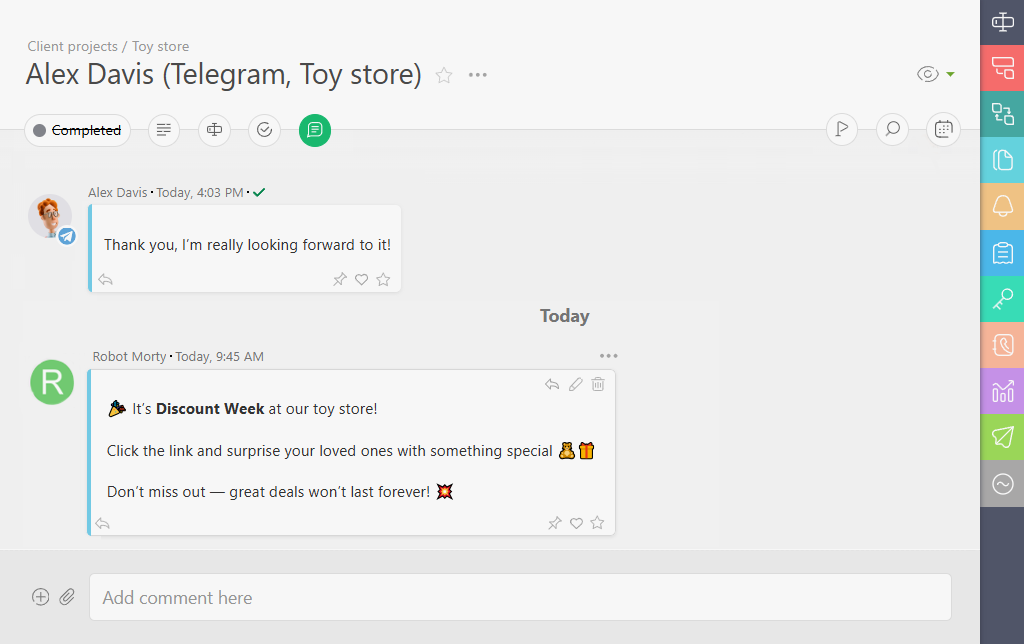
Abandoned cart recovery is one of the most immediate ROI opportunities in e-commerce, with the potential to recover 10-15% of otherwise lost sales. Ecommerce and CRM integration enables automated workflows that trigger personalized recovery emails or SMS messages when a shopper abandons their cart.
Beyond cart recovery, automation can handle post-purchase follow-ups, birthday offers, replenishment reminders, and other timely communications that keep your brand top-of-mind. These automated touchpoints create additional purchase opportunities without requiring manual effort from your team.
Improved Analytics and Sales Forecasting
When your CRM integrates with your e-commerce platform, you gain deeper insights into the customer journey and purchasing patterns. You can track which marketing channels drive the highest lifetime value customers, which products are frequently purchased together, and which customer segments have the highest retention rates.
These insights allow for more accurate sales forecasting, inventory planning, and marketing budget allocation. Instead of making business decisions based on gut feelings, you can leverage actual customer data to guide strategic planning.
These benefits combine to reduce churn, increase loyalty, and streamline team workflows. When executed properly, CRM in ecommerce doesn’t just improve customer relationships — it transforms your entire approach to running an e-commerce business.

Signs Your Online Store Needs CRM Integration
While ecommerce CRM integration offers benefits to virtually any e-commerce business, certain signs indicate that it has moved from being a nice-to-have to an urgent necessity. If you recognize several of these symptoms in your operations, it’s likely time to prioritize integrating a CRM system with your online store.
Disconnected Data Between Marketing, Sales, and Support
One of the most obvious signs is when your teams are working with different sets of customer information. If your marketing team can’t see which customers have open support tickets, or your customer service representatives don’t know which promotional email triggered a purchase, you’re operating with a significant handicap. This disconnection leads to inconsistent customer experiences and missed opportunities for cross-selling and upselling.
For example, if a customer contacts support about a delayed shipment, but your team can’t see that this is a VIP customer who has spent thousands on your store, you might provide standard rather than priority assistance, potentially damaging a valuable relationship.
Difficulty Tracking Customer Interactions
If you find yourself searching through email threads, chat logs, and order notes to piece together a customer’s history with your brand, that’s a clear indicator that you need a centralized CRM solution. The inability to quickly access a complete interaction history prevents you from providing personalized service and makes it difficult to identify patterns in customer behavior.
This problem compounds as your business scales — what might be manageable with a few dozen daily orders becomes impossible with hundreds or thousands of interactions across multiple channels.
Lack of Automation in Order Handling or Follow-ups
When your team is manually sending order confirmations, shipping updates, abandoned cart reminders, or replenishment emails, you’re investing unnecessary labor in processes that could be automated. More concerning, manual processes are prone to inconsistency and human error, leading to missed opportunities and unpredictable customer experiences.
As your order volume grows, the inability to automate routine communications becomes increasingly problematic, taking valuable time away from activities that truly require human attention.
Declining Repeat Purchases or Customer Engagement
Perhaps the most troubling sign is when your metrics show decreasing customer loyalty. If your repeat purchase rate is falling or engagement with your marketing communications is dropping, it often indicates that you’re failing to nurture customer relationships effectively.
Without a CRM to help you identify at-risk customers, personalize communications, and trigger timely follow-ups, it’s difficult to maintain the engagement that drives long-term customer value. In an era where acquisition costs continue to rise, this inability to retain customers can seriously threaten business sustainability.
If these signs resonate with your current situation, implementing CRM ecommerce integration should be a priority. The good news is that the process, while requiring thoughtful planning, can be approached systematically to minimize disruption and maximize results.
How to Integrate CRM with Your eCommerce Platform
Successfully connecting your CRM system with your e-commerce platform requires careful planning and execution. Here’s a simplified roadmap that any e-commerce brand can follow:
1. Define Your Goals and KPIs
Before diving into technical implementation, clarify what you want to achieve through CRM integration with e-commerce. Common objectives include:
- Reducing customer churn by a specific percentage.
- Increasing the repeat purchase rate.
- Improving support response time.
- Boosting email marketing conversion rates.
- Automating specific workflows like abandoned cart recovery.
For each goal, establish measurable KPIs that will help you evaluate success. This preparation ensures your integration focuses on business outcomes rather than just technical connectivity.
2. Audit Your Current Tools and Processes
Take inventory of your existing systems, including:
- Your e-commerce platform and any plugins or extensions.
- Marketing tools (email platforms, social media schedulers, etc.).
- Customer support software.
- Analytics and reporting tools.
- Manual processes that could be automated.
Document how data currently flows between these systems and identify gaps or redundancies. This audit will help you understand what needs to be connected and which processes could be improved through integration.
3. Choose a CRM that Supports Integration
Select a CRM system that aligns with your business needs and offers robust integration capabilities with your e-commerce platform. Planfix stands out as an excellent option for e-commerce businesses due to its flexibility, comprehensive task management, and powerful automation features.
When evaluating CRM options, consider:
- Native integrations with your e-commerce platform.
- API flexibility for custom connections.
- Scalability to grow with your business.
- User-friendliness for your team.
- Cost relative to expected ROI.
Take advantage of free trials to test compatibility with your specific needs before committing.
4. Set Up API or Middleware
Based on your technical resources and requirements, choose the appropriate integration method:
- Native integrations: Many e-commerce platforms offer built-in connections to popular CRMs through their app marketplaces. These are typically the simplest to implement.
- Middleware solutions: Tools like Zapier, Integromat, or Automate.io can connect your systems without requiring developer expertise.
- Custom API integration: For more complex requirements, a developer can create custom connections using your CRM’s API documentation.
Planfix offers flexible API options and pre-built integrations that make this step straightforward for most e-commerce businesses.
5. Map Your Data Flows
Determine which data should sync between systems and in which direction. Common data mappings include:
- Customer profiles: Name, contact information, addresses.
- Order data: Products purchased, order value, coupons used.
- Support tickets: Customer inquiries and resolutions.
- Marketing engagement: Email opens, clicks, campaign responses.
- Website behavior: Product views, cart additions, checkout abandonment.
For each data point, specify whether it should flow one-way or bidirectionally between systems. This mapping prevents data conflicts and ensures you’re capturing the information most valuable to your business goals.
6. Test and Monitor Integration
Before fully deploying your integration:
- Run test scenarios to verify that data flows correctly.
- Check for duplicate records or missing information.
- Confirm that automated workflows trigger as expected.
- Train team members on the new system and processes.
After launch, closely monitor performance against your established KPIs and make adjustments as needed. Integration is not a one-time project but an ongoing process of optimization.
These steps ensure minimal disruption and maximum ROI from your integration efforts. While the technical aspects might seem daunting, platforms like Planfix simplify the process with user-friendly interfaces and dedicated support resources.
Common Mistakes in CRM Integration (and How to Avoid Them)
Even with the best intentions, many e-commerce businesses stumble during CRM implementation. Understanding these common pitfalls can help you navigate the integration process more successfully:
Not Involving the Sales/Support Team in Setup
The mistake: Technical teams often implement CRM systems with minimal input from the people who will use them daily. This leads to systems that work theoretically but fail to address real-world workflows and requirements.
The solution: Make your CRM implementation a cross-functional project. Include representatives from sales, marketing, customer support, and operations in the planning process. Ask them about their daily challenges, information needs, and workflow bottlenecks. Use their feedback to configure the system and prioritize integration points.
For example, your support team might highlight the need to see recent marketing communications when handling customer inquiries, while your sales team might prioritize visibility into past support interactions — details you might miss without their direct input.
Poor Data Mapping or Duplicate Entries
The mistake: Rushing the data mapping process often results in duplicate customer records, inconsistent information across systems, or critical data not being transferred. These issues can undermine trust in the system and create more work than they save.
The solution: Invest time in thorough data planning.
- Create unique identifiers to match records across systems.
- Establish clear rules for which system “owns” which data points.
- Implement validation rules to maintain data quality.
- Plan for handling conflicts when the same information exists in multiple systems.
- Schedule regular data audits to catch and resolve issues.
Taking these steps prevents the frustration and inefficiency of working with fragmented or duplicate customer data.
Choosing a CRM Without Proper API Support
The mistake: Some businesses select a CRM based solely on marketing features or user interface, only to discover later that it lacks the technical capabilities to integrate properly with their e-commerce platform or other critical tools.
The solution: Make API capabilities and integration options a primary selection criterion. Before committing to a CRM:
- Verify it has direct integration with your e-commerce platform or robust API documentation.
- Check if it supports the specific data types you need to transfer.
- Assess whether it can handle your current and projected data volumes.
- Confirm it can accommodate your desired automation workflows.
- Read reviews specifically about integration experiences from businesses similar to yours.
Planfix stands out in this area, offering flexible API options and pre-built connectors for major e-commerce platforms that simplify the integration process.
Ignoring GDPR/Data Protection Practices
The mistake: In the rush to consolidate customer data, businesses sometimes overlook privacy regulations like GDPR, CCPA, or other regional requirements. This can lead to significant legal and financial risks.
The solution: Make compliance a foundational element of your integration strategy:
- Document what customer data you’re collecting and why.
- Implement clear consent mechanisms for data collection.
- Ensure your CRM supports data deletion and portability requests.
- Create processes for handling privacy requests across integrated systems.
- Limit data access to team members who genuinely need it.
Proper compliance not only reduces legal risk but also builds customer trust in how you handle their information.
Attempting Too Much Automation at Once
The mistake: Excited by automation possibilities, companies sometimes try to implement too many complex workflows simultaneously, leading to confusion, errors, and overwhelmed team members.
The solution: Take an incremental approach to automation:
- Start with simple, high-impact workflows like order confirmations or abandoned cart recovery.
- Thoroughly test each automation before moving to the next.
- Document each automated process for team reference.
- Collect feedback and refine before adding complexity.
- Measure the results of each automation to verify ROI.
This methodical approach ensures that your team can adapt to changes and that each automation delivers measurable value.

By avoiding these common pitfalls, you can ensure that your CRM integration with e-commerce delivers the expected benefits without unexpected complications or resistance from your team.
Boosting Your eCommerce Business with CRM
CRM and e-commerce integration is no longer optional — it’s key to scaling an e-commerce business in 2026. As competition intensifies and acquisition costs rise, maximizing customer lifetime value through personalized experiences has become a fundamental competitive advantage.
Connecting your CRM with your e-commerce platform creates the infrastructure needed to deliver personalization at scale, automate routine processes, and gain actionable insights from customer data. Whether recovering abandoned carts, increasing repeat purchases, or providing responsive support, an integrated CRM provides the essential foundation.
Tools like Planfix make this process accessible even for businesses without extensive technical resources. With flexible integration options, powerful automation capabilities, and intuitive interfaces, sophisticated customer relationship management is within reach for companies of all sizes.
Implementing an effective e-commerce CRM strategy has become essential for companies looking to compete in today’s market. By using CRM data in ecommerce, businesses can create more personalized shopping experiences and identify opportunities for growth. The right e-commerce CRM solution can transform how you engage with customers and manage your business operations.
As we look at ecommerce CRM trends, we’re seeing greater focus on AI-powered personalization and predictive analytics. More businesses are also using e-commerce CRM solutions for inventory management to better forecast demand and optimize stock levels. For online retailers seeking a competitive advantage, developing a comprehensive e commerce CRM strategy is no longer optional — it’s a necessity for sustainable growth.

