
- What Are Planfix AI Agents?
- How Does Artificial Intelligence WorkflowWork?
- How Can AI Automate Tasks?
- Routine Workflows That Can Be Automated
- Is AI Task AutomationWorth It?
- Key Features That Make Planfix AI Bots Stand Out
- Real-World Use Case: Automating First-Line Support
- Getting Started with Planfix AI Bots
- The Future of Workflow Automationwith AI
- Why Planfix AI Bots Deserve a Place in the Modern AI Stack?
- Final Thoughts
In today’s rapidly evolving business landscape, artificial intelligence is fundamentally reshaping how we approach modern work. Companies across industries are discovering that routine, repetitive tasks are silently draining productivity and preventing teams from focusing on high-value activities that drive real growth. While businesses desperately seek smarter, scalable solutions to overcome these operational bottlenecks, many struggle to find tools that seamlessly integrate AI into their existing workflows without requiring extensive technical expertise.
Enter Planfix AI Bots — a revolutionary no-code platform that brings the power of artificial intelligence workflow automation directly into real business processes. Unlike standalone AI tools that operate in isolation, Planfix AI Bots work within your existing operational framework, transforming how teams handle everything from email management to task assignment and document generation.
What Are Planfix AI Agents?
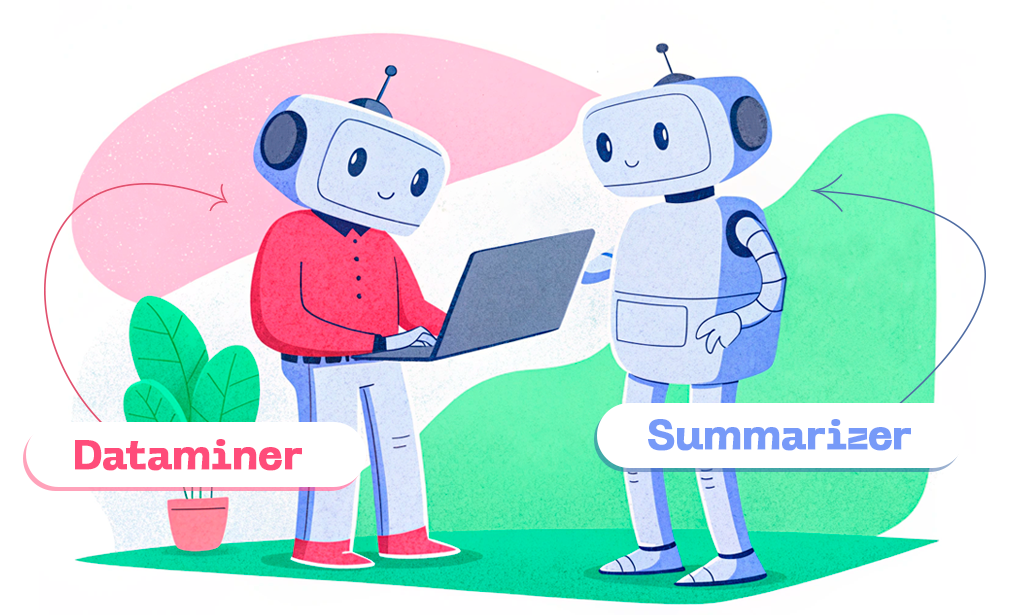
Planfix AI Bots are built-in features of the Planfix ecosystem that blend AI’s natural language processing capabilities with the platform’s flexible rule-based logic. Unlike traditional bots that simply follow pre-written scripts, Planfix AI Bots act as dynamic agents. They interpret the content of emails, comments, or tasks, and generate actionable outcomes — such as filling in custom fields, summarizing conversations, or launching workflows.
Two of the standout bots currently available are:
- The AI-powered tool Dataminer scans unstructured text (such as emails or task comments) and extracts relevant data into structured fields.
- By using the Summarizer feature, entire comment threads are reviewed and transformed into clean, concise summaries, saving time for project managers and team leads.
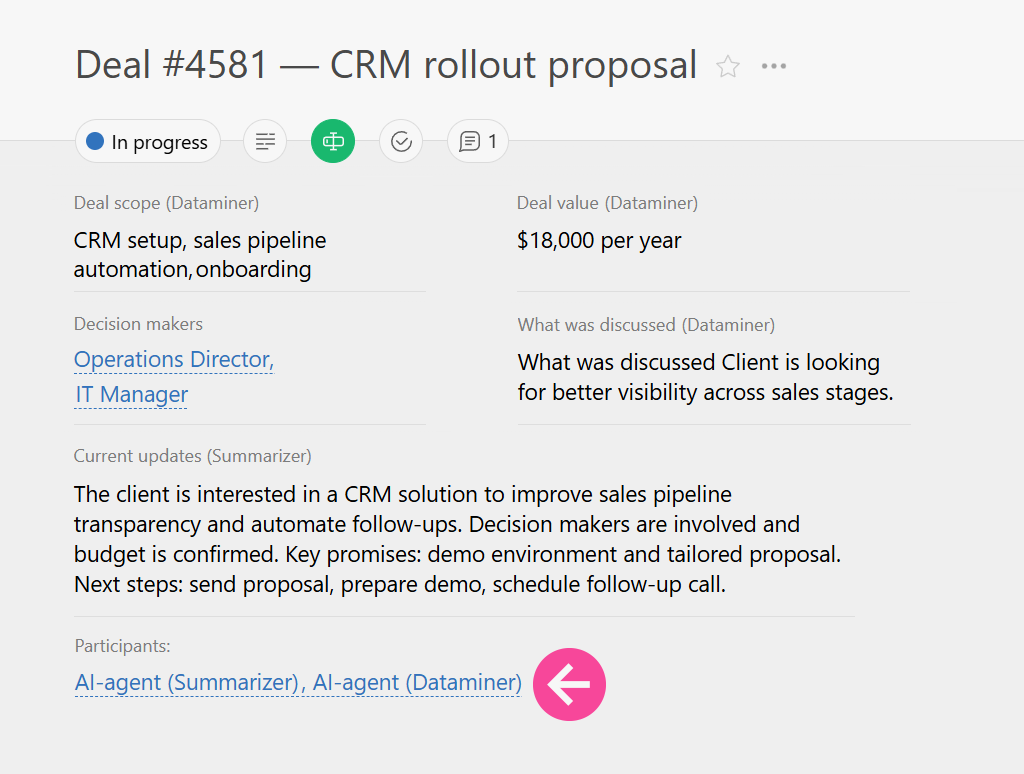
These bots form the core of Planfix’s AI automation platform, providing businesses with a simple interface to incorporate powerful AI into their operations.
To better understand how tools like these operate in context, let’s take a step back and explore the foundational principles of artificial intelligence workflow automation.
How Does Artificial Intelligence Workflow Work?
Understanding how artificial intelligence workflow systems operate in business environments requires examining the fundamental process of how AI interprets and acts on business data. Modern AI workflow automation works by continuously monitoring and analyzing various types of business communications and data inputs in real time.
When integrated into business operations, AI systems read and interpret diverse data sources including emails, task comments, form submissions, and custom field values. This continuous data analysis allows the AI to understand context, identify patterns, and extract meaningful insights from unstructured information that would typically require human interpretation.
Based on predefined instructions and learning patterns, the AI system triggers specific workflow actions. These actions might include automatically assigning tasks to appropriate team members, filling in relevant data fields, generating comprehensive summaries of complex information, or initiating multi-step business processes. The key advantage of this approach is that AI doesn’t replace existing business tools but rather augments human decision-making and automates routine process steps that consume valuable time and resources.
This integration approach ensures that AI workflow automation becomes a natural extension of existing business processes rather than a disruptive replacement. Teams continue working with familiar tools and interfaces while benefiting from intelligent automation that handles repetitive tasks in the background.
How Can AI Automate Tasks?
The logic behind AI task automation centers on identifying repetitive tasks that follow predictable patterns and using artificial intelligence to analyze content and make decisions that humans would otherwise handle manually. This approach to automate tasks transforms time-consuming manual processes into efficient, automated workflows.
Common examples of tasks ripe for AI automation include tagging and categorizing emails based on content, responding to frequently asked questions with appropriate template responses, and assigning tasks to team members based on workload, expertise, or availability. Each of these processes involves pattern recognition and decision-making that AI can handle effectively once properly configured.
The power of AI automation becomes particularly evident in scenarios requiring content analysis and intelligent routing. For instance, AI can recognize different types of customer requests by analyzing email content, subject lines, and sender information. It can extract key information from lengthy messages, identifying critical details like deadlines, priority levels, budget constraints, or technical specifications. Based on this analysis, the system can generate follow-up tasks, create comprehensive summaries for management review, or produce detailed reports instantly.
The key to successful AI automation platform implementation lies in identifying processes where intelligent decision-making can replace human judgment for routine decisions. While AI shouldn’t replace human oversight for complex or sensitive decisions, it excels at handling the repetitive analytical tasks that consume significant time but don’t require creative problem-solving or nuanced judgment.
To better understand the value AI brings to everyday workflows, consider the following examples that show how automation dramatically reduces the time spent on routine tasks.
| Task Type | Manual Process Time | AI Automation Time | Time Saved |
| Email Classification | 2-3 minutes per email | 5-10 seconds | 95% reduction |
| Task Assignment | 5-10 minutes per task | Instant | 100% reduction |
| Summary Generation | 15-30 minutes | 30-60 seconds | 97% reduction |
| Document Creation | 20-45 minutes | 2-5 minutes | 85% reduction |
As this comparison shows, AI significantly increases efficiency by taking over high-frequency, low-complexity tasks — freeing up teams to focus on work that requires human insight.
Routine Workflows That Can Be Automated
These are some of the most common processes where AI automation can make an immediate impact, starting with:
Email Sorting and Request Classification
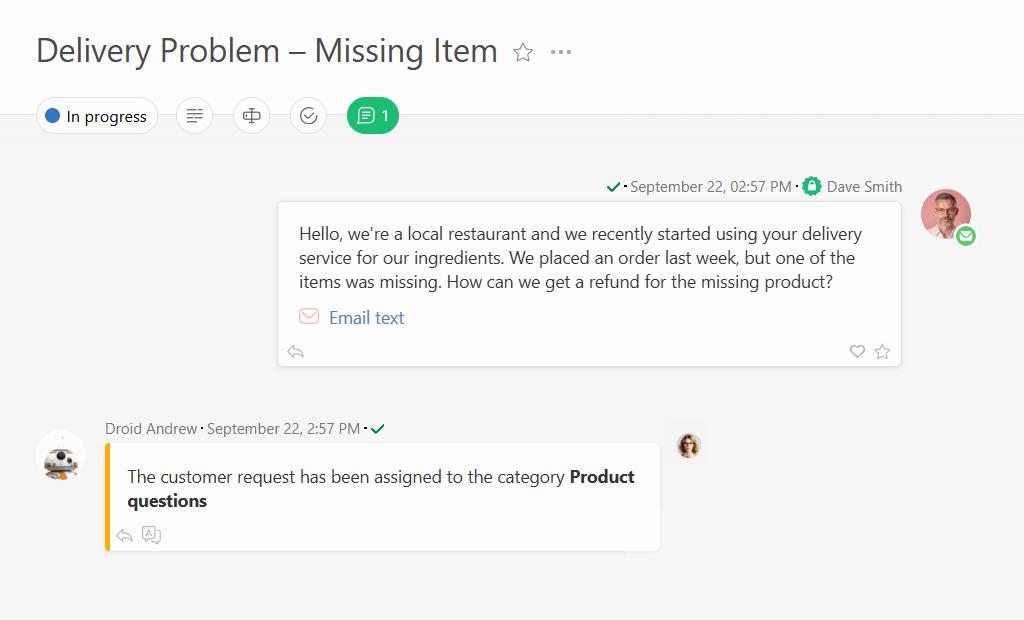
One of the most powerful uses of AI workflow automation is the automatic sorting and categorization of incoming emails and requests. Traditionally, this required team members to manually review each message, determine its priority, and forward it to the right person or department — often consuming hours of valuable time. With built-in email integration in platforms like Planfix, this process is streamlined: emails are automatically converted into categorized tasks. AI analyzes the content, subject line, sender, and attachments to determine the nature of the request, fill in relevant fields, and trigger appropriate actions — such as assigning tasks, setting priorities, or launching response protocols. As a result, urgent issues are handled immediately, and routine messages are processed efficiently without manual input.
Task Creation and Routing
Intelligent task creation and routing represents another powerful application of AI tools for automation. When requests arrive through various channels—email, web forms, or direct communications—AI can analyze the content to identify the type of work required, estimate complexity levels, and automatically create appropriate tasks with relevant details pre-filled.
The system can extract key information such as deadlines, budget constraints, technical requirements, or customer preferences and use this data to assign tasks to team members with the right expertise and availability. This automated routing ensures that work is distributed efficiently while reducing the administrative overhead of manual task assignment.
Generating Summaries
AI-powered summary generation transforms how teams handle information management and reporting. Rather than requiring managers to read through lengthy task comment threads, project updates, or customer communication histories, AI can analyze this content and generate concise, actionable summaries that highlight key points, decisions made, and next steps required.
This capability proves particularly valuable for executive reporting, project status updates, and client communications where stakeholders need quick access to essential information without wading through detailed conversation histories.
Document Generation
Automated document generation using AI workflow tools streamlines the creation of contracts, invoices, proposals, and other business documents. AI can pull relevant information from task details, customer records, and project specifications to populate document templates automatically. This process eliminates manual data entry while ensuring consistency and accuracy across all generated documents.
The system can also customize document content based on specific criteria, such as adjusting contract terms based on client tier, modifying invoice formats for different regions, or including specific clauses based on project requirements.
Recurring Task Automation
Planfix AI Bots excel at handling recurring business processes that require regular execution but don’t need human creativity or judgment. This includes generating weekly reports, sending reminder notifications, updating project statuses, or processing routine administrative tasks. By combining AI intelligence with Planfix’s rule engine, businesses can automate AI processes that ensure important recurring activities never get overlooked.
Is AI Task Automation Worth It?
The business case for implementing AI task automation solutions becomes compelling when examining the concrete benefits organizations experience after deployment. Time savings represent the most immediate and measurable benefit, with many organizations reporting elimination of 10-20 hours per week of manual work previously required for routine tasks like email triage, data entry, and basic customer service responses.
Error reduction provides another significant advantage of AI automation platform implementation. Human processing of repetitive tasks inevitably leads to inconsistencies, missed details, and occasional mistakes, especially during busy periods or when handling large volumes of similar requests. AI systems process information consistently according to predefined criteria, dramatically reducing errors caused by fatigue, distraction, or simple oversight.
Scalability benefits become particularly important as businesses grow. Traditional manual processes require proportional increases in staff to handle growing volumes of work. AI powered workflows can handle dramatically increased workloads without requiring additional human resources, allowing businesses to scale operations efficiently while maintaining service quality.
The return on investment for AI automation typically becomes evident within weeks of implementation. While initial setup requires time investment to configure rules and train the system, businesses benefit daily from reduced manual work, faster response times, and improved accuracy. Many organizations report that AI automation pays for itself within the first quarter through time savings alone, with additional benefits in improved customer satisfaction and reduced operational stress.
Key Features That Make Planfix AI Bots Stand Out
Planfix AI distinguishes itself in the crowded automation AI tools marketplace through several key features that address common barriers to AI adoption in business environments.
The table below outlines how Planfix AI Bots compare to traditional AI tools across critical implementation factors:
| Feature | Traditional AI Tools | Planfix AI Bots |
| Setup Complexity | Requires coding/technical skills | No-code visual configuration |
| Data Integration | Export/import required | Native platform integration |
| Workflow Flexibility | Limited predefined templates | Custom rule-based workflows |
| Security Model | External data processing | All processing within platform |
| Learning Curve | Weeks to months | Hours to days |
| Maintenance | Ongoing technical support needed | Self-service management |
By combining no-code setup, deep data integration, and robust in-platform security, Planfix AI empowers businesses to implement intelligent automation without the usual complexity or risk. This makes it an ideal choice for teams seeking to streamline operations, reduce manual effort, and unlock the full potential of their internal workflows — all within a secure, user-friendly environment.
Real-World Use Case: Automating First-Line Support
A practical example of AI in workflow automation demonstrates how Planfix AI Bots transform traditional support processes into efficient, automated systems. Consider a typical customer support scenario where emails arrive at a shared inbox throughout the day, requiring manual triage and routing to appropriate team members.
When an email arrives in the shared inbox, the Planfix AI Bot immediately analyzes the message content, subject line, and any relevant customer history to identify the request type. This analysis might categorize the request as a technical issue, billing question, feature request, or general inquiry based on keywords, context, and historical patterns.
The system automatically fills in the request type field based on this analysis, which triggers a predefined Planfix process. This process creates a new support task, assigns it to the appropriate team member based on expertise and current workload, and adds a template response acknowledging receipt of the request and providing estimated response times.
Throughout the week, the AI continues processing requests and updating relevant fields. At the end of each week, the system automatically generates a comprehensive summary for the support manager, including metrics on request volumes by category, average response times, and any trends or patterns identified in customer communications.
This automated approach transforms a manual process that might require 2-3 hours daily into an automated system that handles routine triage and routing while providing valuable insights for continuous improvement.
Getting Started with Planfix AI Bots
Implementing your first AI workflow automation solution with Planfix AI Bots follows a straightforward process designed to help businesses achieve quick wins while building confidence with the technology.
Step-by-Step Implementation Guide
Phase 1. Foundation Setup (Week 1):
- Create custom field for AI results storage.
- Define field properties and validation rules.
- Set up user permissions and access controls.
- Document current manual process for comparison.
Phase 2. Rule Configuration (Week 2):
- Identify trigger events for AI activation.
- Configure automation rule conditions.
- Set up “Send to AI” action parameters.
- Define result storage locations.
Phase 3. Testing & Optimization (Week 3):
- Deploy in controlled test environment
- Process sample data through system
- Validate AI accuracy and rule logic
- Refine configurations based on results
Phase 4. Production Deployment (Week 4):
- Roll out to live business processes
- Monitor performance and accuracy
- Train team on new automated workflows
- Document processes for future scaling
Quick Start Checklist
| Task | Estimated Time | Difficulty Level |
| Custom field creation | 15 minutes | Beginner |
| Basic automation rule | 30 minutes | Beginner |
| AI action configuration | 45 minutes | Intermediate |
| Testing and validation | 2-3 hours | Intermediate |
| Production deployment | 1 hour | Beginner |
This staged approach helps ensure reliability while building team confidence in the automated system, allowing businesses to scale their AI automation efforts based on proven success with initial implementations.
The Future of Workflow Automation with AI
The evolution of AI workflow automation tools represents a fundamental shift from standalone automation bots to deeply embedded AI systems that integrate seamlessly with business platforms. Rather than treating AI as a separate tool that requires data export and import processes, the future lies in AI systems that work natively within existing business environments.
This shift means AI no longer just assists with tasks but actively drives business processes, making intelligent decisions and initiating complex workflows based on real-time analysis of business data. Planfix AI exemplifies this evolution by demonstrating what becomes possible when AI is embedded directly in everyday business operations rather than operating as an external service.
The importance of no-code AI solutions will continue growing as businesses seek to implement intelligent automation without extensive technical resources or lengthy development cycles. The ability to configure sophisticated AI workflows using intuitive interfaces democratizes access to advanced automation capabilities, enabling smaller businesses and non-technical teams to benefit from AI-powered efficiency improvements.
Looking toward 2025 and beyond, successful AI implementations will be characterized by seamless integration, ease of configuration, and focus on practical business outcomes rather than technological complexity. Organizations that embrace this approach will gain significant competitive advantages through improved efficiency, reduced operational costs, and enhanced ability to scale operations.
Why Planfix AI Bots Deserve a Place in the Modern AI Stack?
For businesses evaluating AI automation platform options, Planfix AI Bots offer a unique combination of business process management capabilities with embedded AI functionality that operates directly within task management workflows. This integration approach provides real, measurable automation benefits rather than limiting AI to conversational interactions.
The platform represents an ideal solution for teams seeking scalable, secure, no-code AI tools that integrate with existing business processes. Unlike standalone AI tools that require complex integration efforts, Planfix AI works within a comprehensive business management platform that teams already use for project management, communication, and workflow coordination.
As a practical AI-powered platform, Planfix AI complements rather than competes with popular tools like ChatGPT or Zapier. While ChatGPT excels at conversational AI and content generation, and Zapier provides excellent app integration capabilities, Planfix AI focuses specifically on intelligent workflow automation within business processes. This specialization allows organizations to use AI to automate tasks that directly impact daily operations and productivity.
The platform’s approach to combining AI intelligence with business process management creates opportunities for automation that wouldn’t be possible with separate tools. By understanding the context of tasks, projects, and business relationships, Planfix AI can make more intelligent decisions and trigger more sophisticated automated responses than systems that only access limited data through API connections.
Final Thoughts
Planfix AI Bots transform business workflows by embedding intelligent, no‑code automation directly into the Planfix platform—eliminating tedious manual steps while enhancing accuracy and consistency. Rather than operating as standalone tools, these AI agents integrate natively with familiar interfaces and rule engines, empowering teams to automate everything from email classification and task routing to summary generation and document creation without any programming.
Key highlights:
- Seamless Integration. AI actions are configured through Planfix’s visual rule builder, so automation becomes a natural extension of existing processes—no external scripts or complex setups required.
- Dynamic AI Agents:
- Dataminer extracts structured data from unstructured text (emails, comments).
- Summarizer condenses lengthy threads into clear, actionable overviews.
- Broad Use Cases. Automate routine communications, intelligent task assignments, report and document generation, and recurring notifications to free teams for high‑value work.
- Scalable & Secure. All AI processing occurs within Planfix, ensuring data never leaves the platform and workflows scale seamlessly as demand grows.
- Rapid Value. Early adopters consistently report dramatic reductions in manual effort, faster response times, and a swift return on implementation investments — making it easier for organizations to standardize operations and focus on strategic objectives.
- Democratized AI. The no‑code approach lowers the barrier to sophisticated automation, enabling both technical and non‑technical teams to configure, test, and refine intelligent workflows in days rather than weeks or months.
By combining powerful natural‑language processing with flexible rule‑based logic, Planfix AI Bots deliver measurable improvements in productivity, operational efficiency, and user satisfaction — positioning them as a leading choice for organizations seeking trustworthy, embedded AI workflow automation.

