

Why Modern Farms Need a CRM
Farming is no longer just about planting and harvesting; it is a complex logistics and supply chain business. Relying on notebooks or disjointed spreadsheets leads to data silos, missed supplier renewals, and inefficient inventory usage.
A Customer Relationship Management (CRM) system for a farm does more than manage “customers.” It serves as a central operational hub. The right CRM helps agribusinesses manage supplier contracts, track harvest yields, monitor machinery maintenance, and streamline communication with distributors.
When selecting a CRM for agriculture, prioritize these capabilities:
- Supplier & Vendor Management: Centralized databases for feed, seed, and fertilizer contracts.
- Task Management: Assigning field tasks to workers (e.g., “Spray Field B on Tuesday”).
- Inventory Tracking: Real-time visibility into stock levels to prevent shortages.
- Mobile Accessibility: Offline capabilities for accessing data in remote fields.
- Customization: The ability to adapt the software to specific crops or livestock types.
Top CRM & Management Software for Farms (2025)
Below is an analysis of the most effective platforms, ranging from highly flexible work management systems to niche agricultural tools.
1. Planfix
Best For: Custom workflows, supplier management, and operational flexibility.
Planfix is a highly customizable management platform that excels in scenarios where “out-of-the-box” software feels too rigid. Unlike niche farm software that forces you into a specific way of working, Planfix allows farm managers to build their own ecosystem.
- Supplier Management: You can create a dedicated contact database for suppliers, attach contracts directly to their profiles, and set automated reminders for re-ordering supplies or renewing agreements.
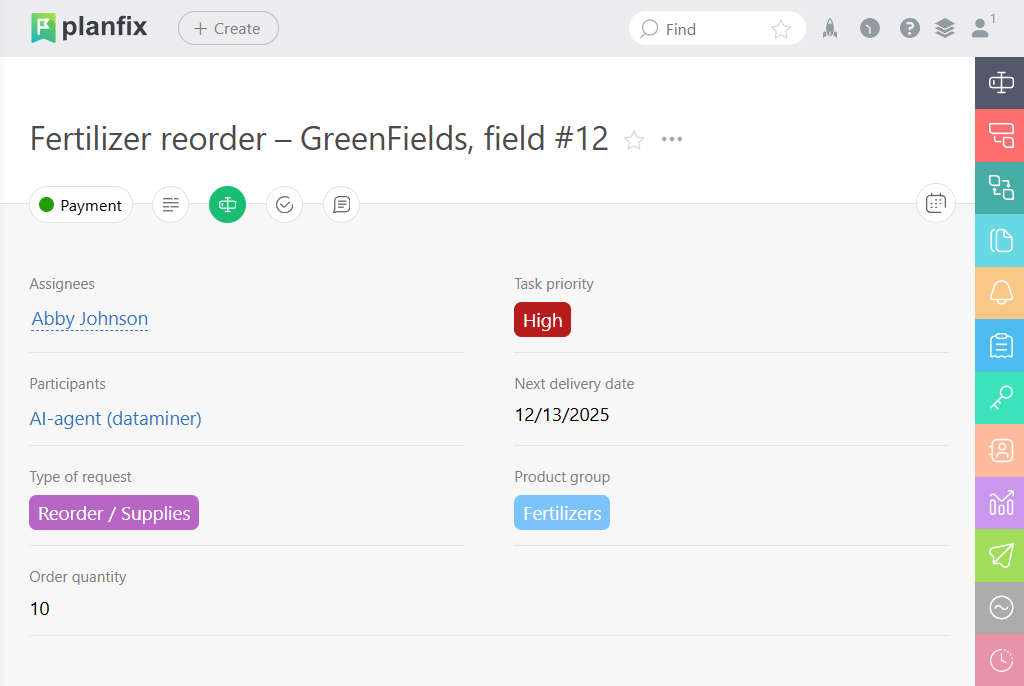
- Field Operations: Planfix allows you to turn a “field” into a project. You can track expenses, labor hours, and inputs (fertilizer/seeds) specific to that plot of land.
- Machinery Maintenance: Create recurring tasks for tractor or combine services based on dates or usage hours.
- Omnichannel Communication: If you sell directly to consumers or distributors, Planfix aggregates orders from email, messengers (WhatsApp/Telegram), and phone calls into a single ticket system.
2. AgriWebb
Best For: Livestock and grazing management.
AgriWebb is a specialized tool designed primarily for ranchers and livestock farmers. It focuses heavily on mapping and animal health.
- Livestock Tracking: Detailed records of animal weight, health treatments, and movements between paddocks.
- Grazing Management: Visual maps showing grazing days per paddock to prevent overgrazing.
- Inventory: Tracks medicine and feed usage, automatically deducting from inventory when treatments are logged.
- Limitation: It is less effective for mixed farms with heavy arable (crop) operations or complex supplier procurement needs outside of livestock.
3. Granular (by Corteva)
Best For: Financial analysis and large-scale crop agronomy.
Granular is a heavy-hitter in the arable farming sector, focusing on profitability and land management.
- Profit & Loss Analysis: Granular excels at breaking down P&L on a field-by-field basis.
- Agronomy Integrations: Connects with John Deere Operations Center to pull machine data automatically.
- Work Orders: Generates specific work orders for farmhands tailored to crop protection schedules.
- Limitation: Can be expensive and complex to set up for smaller family farms.
4. Bushel Farm (formerly FarmLogs)
Best For: Grain marketing and crop scouting.
Bushel Farm is designed for grain farmers who need to keep a close eye on market prices and field conditions.
- Rainfall & Heat Monitoring: Uses satellite data to track weather impact on specific fields.
- Marketing: Helps track grain contracts and sales to maximize revenue.
- Scouting Notes: Mobile app allows users to tag geo-located notes about pests or diseases while in the field.
Comparison Table: Farm CRM & Management Tools
| Feature | Planfix | AgriWebb | Granular | Bushel Farm |
| Primary Focus | Flexible Operations & Supplier Mgmt | Livestock & Grazing | Financials & Agronomy | Financials & Agronomy Grain Marketing & Crops |
| Supplier Database | Advanced (CRM based) | Basic | Basic | Basic |
| Custom Workflows | High (No-code builder) | Low (Fixed structure) | Medium | Low |
| Offline Mobile App | Yes | Yes | Yes | Yes |
| Inventory Tracking | Yes (Customizable) | Yes (Medicine/ Feed) | Yes (Inputs) | Yes (Grain) |
| Ideal User | Mixed farms needing custom processes | Ranchers/ Cattle stations | Large crop enterprises | Grain farmers |
Key Selection Criteria: Why Flexibility Matters
While niche software (like AgriWebb or Granular) is excellent for specific agronomy data, they often lack strong business process management features.
For example, if a tractor breaks down, niche software might track the cost, but it rarely manages the process of ordering the part, scheduling the mechanic, and tracking the supplier invoice.
Planfix stands out in this regard because it handles the business side of farming. You can set up a scenario where a farmhand reports a broken fence via the mobile app, which automatically creates a task for the maintenance team and alerts the manager to order materials. This connectivity between tasks, suppliers, and inventory is what drives efficiency.
FAQ
Do I need a specialized Farm CRM or a general CRM?
It depends on your complexity. If you need deep agronomic data (soil health, satellite imagery), use specialized tools like Granular.
However, if your main struggle is organizing tasks, managing supplier contracts, and sales, a flexible general platform like Planfix is often more effective and affordable.
Can these systems work offline?
Yes. Offline capability is critical for farming.
Planfix, AgriWebb, and Bushel Farm all have mobile apps that cache data, allowing you to log information in the field and sync when you return to Wi-Fi coverage.
How does a CRM help with Supplier Management?
A CRM creates a history of interactions.
You can see exactly how much fertilizer you bought from a specific vendor last year, compare prices, and set automated reminders to renegotiate contracts before the busy season starts.
Is it difficult to implement a CRM on a farm?
Implementation requires time.
However, platforms like Planfix are “no-code,” meaning you can start simple (e.g., just tracking tasks) and add complex inventory or supplier workflows as your team gets comfortable with the software.
Can I track harvest yields in these systems?
Yes. In niche apps (AgriWebb/Bushel), this is a default feature.
In Planfix, you can easily create a custom field for “Yield” within a harvest task to track tons/bushels per field and generate reports based on that data.


Thank you for the article, Planfix Team. Clear overview of farm CRMs and their impact on operations and supplier management.