


- Why Static Routes Break in Real Life (and What It Costs)
- How Delivery Route Optimization Works With Real-time Traffic Data
- From Traffic Data to Better ETAs: What Changes Technically
- Operational Features That Make Traffic-based Optimization Usable
- Route Optimization Workflow (What It Looks Like Day-to-day)
- Comparison Table: What to Expect from Courier Management Software
- How to choose the right tool for traffic-based routing
- FAQ
Courier operations don’t fail because dispatchers can’t build routes. They fail because routes become wrong minutes after they’re built: congestion appears, accidents block arteries, customers change availability, and new same-day orders arrive. That’s why modern software for courier management focuses less on “planning a route once” and more on continuously optimizing routes using real-time traffic data, order updates, and field execution signals.
This article breaks down how the optimization actually works, what data is required, and what features matter if you want measurable improvements in on-time delivery and cost per stop.
Why Static Routes Break in Real Life (and What It Costs)
A static plan assumes travel times stay constant. In real courier networks, that assumption is expensive:
- Late deliveries and SLA penalties when travel time spikes.
- More miles due to detours chosen ad hoc by drivers.
- Lower drop density because a “perfect” route becomes infeasible and stops get skipped or reshuffled manually.
- Dispatcher overload from constant calls and manual reassignments.
- Failed deliveries when ETAs drift and customers aren’t ready.
Real-time optimization aims to keep the plan continuously aligned with reality-without turning dispatch into chaos.
How Delivery Route Optimization Works With Real-time Traffic Data
Route optimization is usually a variant of the Vehicle Routing Problem (VRP), extended with real constraints: time windows, capacities, pickup-and-delivery pairing, driver shifts, service times, and priorities. Real-time traffic makes it dynamic VRP-the plan must adapt mid-route.
Core Inputs the System Needs (Beyond Addresses)
To use traffic effectively, courier management software typically requires:
- Geocoded stops (validated coordinates, not just text addresses)
- Time windows (customer availability, delivery promises)
- Service time per stop (handover, signature, photo, ID check)
- Vehicle/driver constraints (capacity, skills, zones, working hours)
- Order priority (express vs standard)
- Live location of couriers (GPS pings)
- Traffic-aware travel time matrix (from mapping providers)
If the system only has addresses and “deliver today,” traffic-aware optimization will still help, but results will be limited.
From Traffic Data to Better ETAs: What Changes Technically
Real-time traffic data improves routing in two main ways:
1) Better Travel Time Estimates (ETA Accuracy)
Instead of calculating distance-based times, the platform uses traffic-aware durations (and sometimes historical patterns by time-of-day). Accurate ETAs enable:
- realistic route feasibility checks.
- proactive customer notifications.
- fewer “impossible routes” that collapse at noon.
2) Continuous Re-optimization (Dynamic Dispatch)
When something changes-traffic surge, a new pickup, a failed attempt-the system can recalculate the best next steps. Common strategies include:
- Rolling horizon planning: optimize the next N stops while keeping later stops flexible.
- Event-based replanning: trigger re-optimization when thresholds are crossed (ETA drift, delay risk).
- Smart insertion: place a new order into an existing route where it adds minimal delay.
- Reassignment: move stops between couriers to restore feasibility and reduce total time.
The practical goal is not mathematical perfection; it’s stable, explainable changes that keep operations on track.
Operational Features That Make Traffic-based Optimization Usable
Real-time optimization fails when it’s “technically correct” but operationally disruptive. Look for these execution-oriented capabilities:
Dispatch Control (Not Just an Algorithm)
- Lock already-started stops to avoid constant reshuffling.
- Allow dispatcher rules (e.g., “don’t reassign after 2 PM”).
- Zone or customer ownership constraints.
Field App Feedback Loop
- driver status: arrived, delivered, failed attempt.
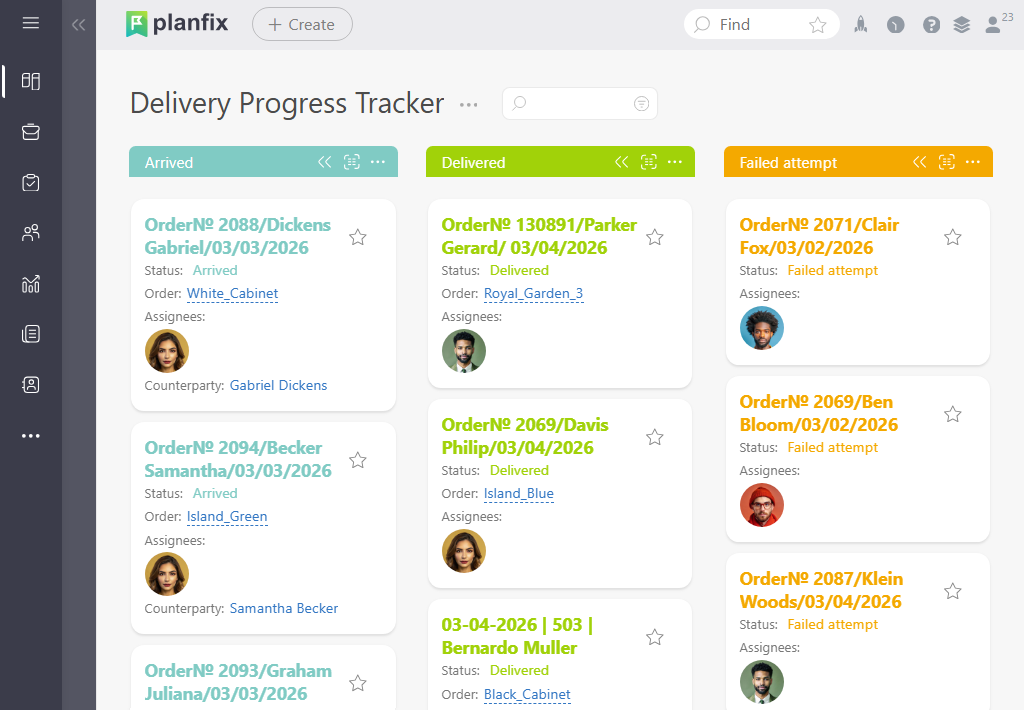
- proof of delivery: signature/photo/barcode scan.
- exception reasons: “customer not home,” “address inaccessible”.
These events are inputs for the next optimization cycle.
Customer Communication Automation
Traffic-aware ETAs matter only if they reach customers:
- dynamic ETA notifications (SMS/email/WhatsApp via integrations)
- rescheduling links
- “driver approaching” alerts
KPI Visibility
Optimization is only valuable if you can measure outcomes:
- on-time rate and lateness distribution.
- cost per stop / miles per stop.
- courier utilization (driving vs service time).
- failed delivery rate by zone and time window.
Route Optimization Workflow (What It Looks Like Day-to-day)
- Orders arrive (manual entry, e-commerce, API, email-to-task).
- Validation: address quality checks, time window enforcement, service-time defaults.
- Initial plan: system builds routes using traffic-aware travel times.
- Dispatch: tasks are assigned and pushed to couriers’ mobile apps.
- Live execution: GPS + statuses + proof-of-delivery events stream back.
- Re-optimization: triggered by delays, new orders, failed attempts, or traffic anomalies.
- End-of-day reconciliation: exceptions, refunds/redeliveries, performance reporting.
Comparison Table: What to Expect from Courier Management Software
The table below focuses specifically on traffic-driven routing and execution-what impacts cost per stop and on-time delivery.
| Criteria | Planfix | Onfleet | Tookan | Circuit for Teams |
| Best fit | Configurable courier workflows + routing + ops control | Last-mile delivery execution with strong tracking | Delivery/dispatch toolkit for SMBs | Simple route planning for small teams |
| Real-time dispatch + reassignment | Yes (workflow-driven, rules-based) | Yes | Yes | Limited (more planning-first) |
| Traffic-aware ETAs | Via integrations/mapping stack + automation logic | Built-in ETAs + tracking | Supports ETAs (depends on setup) | Uses mapping ETAs for routing |
| Workflow automation (no-code) | Strong (tasks, approvals, SLA, exceptions) | Moderate | Moderate | Limited |
| Exception handling (failed attempt loops) | Strong (auto-create re-delivery tasks, SLA timers) | Strong | Moderate | Basic |
| Proof of delivery (photo/signature) | Yes (configurable forms/fields) | Yes | Yes | Limited |
| Reporting depth | Custom dashboards + process analytics | Strong delivery analytics | Basic–moderate | Basic |
| Strength of customization | High (process-first) | Medium | Medium | Low |
Notes: capabilities vary by plan, region, and integrations. The operational difference usually comes down to how well the tool handles exceptions, not how pretty the route map looks.
How to choose the right tool for traffic-based routing
Choose Planfix if You Need Process Control Around Routing
Planfix is a flexible operations platform often used as software for courier management when companies need to connect routing with the full lifecycle: intake → assignment → delivery proof → exceptions → re-delivery → billing/SLA reporting. It’s particularly useful when your “routing problem” is really a workflow problem (frequent exceptions, strict customer rules, complex approvals, multiple service types).
Choose a Delivery-execution Product if You Mostly Need Last-mile Visibility
If your routing is relatively standard and the main pain is live tracking, ETAs, and driver management, tools focused on last-mile execution can be faster to roll out.
Avoid Over-optimizing Too Early
If addresses are messy, service times are unknown, and drivers don’t update statuses, route optimization won’t deliver clean ROI. Fix data quality and field compliance first, then optimize aggressively.
FAQ
What is real-time route optimization in courier delivery?
It’s continuous route planning that updates ETAs and stop sequences using live traffic, courier GPS, and new order/exceptions-so routes stay feasible during the day.
This ensures that drivers are always on the most efficient path, adapting to real-time conditions like traffic and delivery changes.
Does real-time traffic data always reduce mileage?
Not always
It often reduces time first (avoid congestion), which can improve on-time rates. Mileage reduction comes when the system also optimizes stop clustering, insertion, and reassignment rules.
How often should routes be re-optimized?
Common approaches are event-based (when delays exceed thresholds) or periodic (every 5–15 minutes).
Too frequent replanning can confuse drivers, so practical systems lock parts of the route.
What data is required to get accurate ETAs?
Clean geocodes, realistic service times, time windows, and live courier location.
Without service time, ETAs drift even if traffic data is perfect.
Can courier management software handle same-day orders without breaking routes?
Yes, if it supports smart insertion and rule-based reassignment (capacity, time windows, zones).
The key is minimizing disruption while keeping promises.
