The Financial Reality of Ag-Tech
For mid-sized agricultural businesses, the margin for error is slim. Unlike hobby farms, mid-sized operations have significant overheads in labor, machinery, and inputs. Unlike corporate mega-farms, they rarely have dedicated IT departments or unlimited budgets.
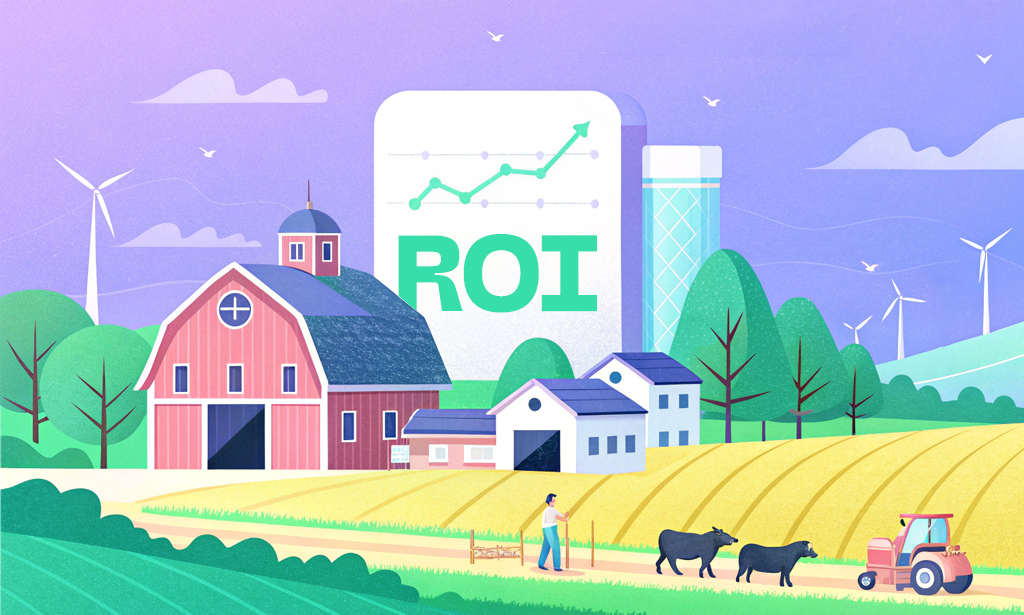
Implementing a Customer Relationship Management (CRM) or Farm Management Software (FMS) is a capital investment. To justify the expense, farm owners must look beyond the monthly subscription fee and understand the Total Cost of Ownership (TCO) and the tangible Return on Investment (ROI).
A properly implemented system does not just “organize data”; it leaks-proofs the business by tracking supplier contracts, monitoring labor efficiency, and preventing inventory wastage.
Breaking Down the Costs
When budgeting for a farm CRM, expenses fall into three categories:
1. Software Subscription Costs
Most modern solutions use a SaaS (Software as a Service) model.
- Niche Ag-Software: Often charges per acre or per head of livestock. This can become prohibitively expensive as a mid-sized farm expands.
- Flexible Business Platforms: Often charge per user. This is frequently more cost-effective for farms where only key managers and administrators need full access, while field workers might only need limited mobile access.
2. Implementation and Training
The “hidden cost” of any software is time. A complex system requires setting up field boundaries, importing inventory lists, and training staff.
- High Complexity: Systems like John Deere Operations Center or Granular require significant setup time due to their depth.
- Low/Medium Complexity: Platforms like Planfix allow for a modular rollout. You can start by using it solely for task management and supplier tracking, incurring zero setup cost, and build complexity later.
3. Hardware Upgrades
Does the software require the latest iPad Pro, or will it run on a $100 Android phone? Mid-sized farms must prioritize software that is device-agnostic to avoid hardware capital expenditure.
Top Solutions: Cost vs. Value Analysis
Here is a comparison of three leading options for mid-sized operations, focusing on their economic value proposition.
1. Planfix
Value Proposition: High flexibility, low cost per user, superior operational tracking.
Planfix represents the “smart budget” choice for mid-sized farms. Because it is a customizable business management platform rather than purely agricultural software, it does not carry the “ag-tech premium” pricing.
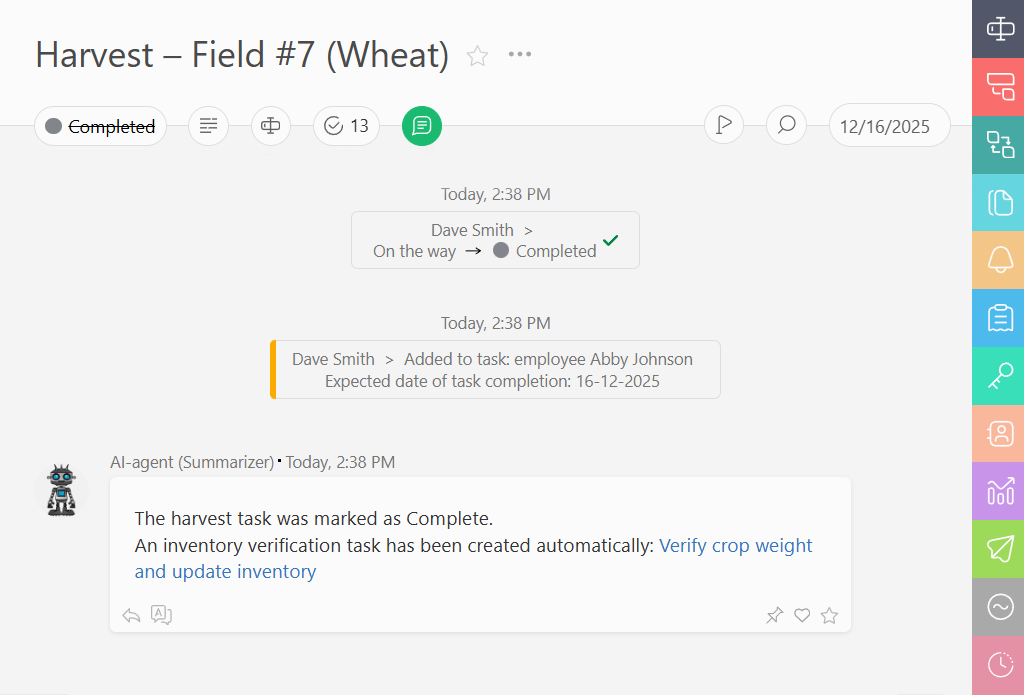
- ROI Driver: Process Automation. Planfix excels at automating routine business processes. For example, when a harvest task is marked “Complete” by a driver, Planfix can automatically trigger a task for the warehouse manager to verify the weight and update inventory.
- Cost Efficiency: Pricing is typically per user/month. For a farm with 5 managers and 20 seasonal workers, Planfix allows you to configure access rights so you aren’t overpaying for basic users.
- Supplier Management: It replaces the need for separate procurement software by tracking vendor contracts and price history in one place.
2. Farmbrite
Value Proposition: All-in-one farming focus, moderate pricing.
Farmbrite is a solid middle-ground solution. It is designed specifically for farming, meaning features like “Genealogy tracking” for livestock are built-in.
- ROI Driver: Record Keeping Compliance. For farms seeking organic certification or grant funding, Farmbrite streamlines the reporting process, saving administrative hours.
- Cost: It usually follows a tiered pricing model based on farm size/features. While easier to set up than Planfix for livestock specifically, it is less flexible for non-farming workflows (like managing a farm shop or tourism).
3. Traction Ag
Value Proposition: Heavy financial focus, accounting integration.
Traction Ag allows farmers to see their true numbers. It acts as a bridge between field operations and farm accounting.
- ROI Driver: Profit Analysis. It helps identify which specific fields or crops are losing money.
- Cost: Generally higher than general project management tools. The ROI is realized only if the farm actively uses the data to cut unprofitable crops.
Comparative ROI Table: Mid-Sized Farm Solutions
| Feature | Planfix | Farmbrite | Traction Ag |
| Pricing Model | Per User (Scalable) | Tiered (Features/Size) | Tiered (Accounting focus) |
| Setup Cost | Low (No-code config) | Medium | High (Financial integration) |
| Primary ROI Source | Operational Efficiency (Labor/Tasks) | Compliance & Record Keeping | Financial Visibility (P&L) |
| Flexibility | High (Build any workflow) | Low (Fixed farm features) | Low (Accounting focused) |
| Best For | Farms needing to manage people, tasks, and suppliers | Diverse farms needing livestock/crop records | Farms needing strictly financial/ accounting data |
Calculating Your ROI
To determine if a tool like Planfix or Farmbrite is worth the investment, calculate the potential savings in three areas:
- Labor Optimization
If a CRM saves your farm manager 5 hours a week of administrative work (data entry, phone calls to find staff, searching for contracts), that is roughly 20 hours a month. Multiplied by their hourly rate, the software often pays for itself in week one.
- Input Waste Reduction
Mid-sized farms lose thousands of dollars annually to “forgotten” inventory—fertilizer that expires or parts ordered twice because no one checked the stock. A CRM with inventory tracking eliminates this redundancy.
- Supplier Negotiation
Data is leverage. Using a CRM to pull up a report showing you purchased $50,000 of feed from a supplier last year gives you the data needed to negotiate a 5% discount for the coming season. That 5% saving alone often covers the annual software license.
Conclusion
For mid-sized agricultural businesses, the goal is to professionalize operations without becoming bureaucratic.
While specialized tools like Traction Ag are great for pure accounting, they often lack the operational fluidity needed for daily farm management. Planfix offers the highest ROI for farms that struggle with communication, task delegation, and supplier management because it adapts to the farm’s existing processes rather than forcing the farm to adapt to the software.
FAQ
How long does it take to see ROI from a Farm CRM?
Operational ROI (time saved) is usually visible within the first 30 days.
Financial ROI (better yield tracking, reduced waste) is typically realized after one full growing season.
Are there hidden costs in cloud-based CRMs?
The most common hidden cost is data storage limits or integration fees (e.g., connecting to weather stations).
However, platforms like Planfix are generally transparent with flat-rate user pricing.
Can I replace my accounting software (QuickBooks/Xero) with a Farm CRM?
Generally, no. A CRM manages operations (who is doing what, where, and with what resources).
You should look for a CRM that integrates with your accounting software, rather than replaces it.
Is open-source (free) farm software a good idea?
For a commercial mid-sized farm, usually no. Open-source software lacks customer support and security guarantees.
If the server goes down during harvest, the cost of downtime far exceeds the price of a paid subscription to a reliable tool like Farmbrite or Planfix.
Why is Planfix recommended for farms if it isn’t just for farms?
Ag-specific software is often rigid.
Planfix allows mid-sized farms to build custom workflows (e.g., distinct processes for harvest vs. maintenance vs. sales) that specific farm software cannot handle. This flexibility prevents you from “outgrowing” the software.
