One Size Does Not Fit All in Agriculture
A 50-acre family orchard and a 10,000-acre corporate grain enterprise have fundamentally different management needs. While both need to track crops and finances, the scale of data and the complexity of workflows differ dramatically.
- Small Farms prioritize simplicity, affordability, and all-in-one functionality. They need tools that reduce paperwork without requiring an IT degree.
- Large Farms prioritize data granularity, integrations with heavy machinery (IoT), and multi-level user permissions. They need robust reporting for stakeholders and compliance.
Choosing the wrong tier of software is a common mistake. Large farms using simple apps create data silos, while small farms using enterprise software waste money on features they never use.
Best CRM Solutions for Small Farms
Small farms often operate with limited staff, meaning the owner is also the manager, the agronomist, and the salesperson. The ideal CRM here acts as a “digital assistant.”
1. Planfix
Why it wins for Small Farms: Versatility and Cost-Effectiveness.
Small farms often have diverse revenue streams — selling crops, running a farm stand, or offering agritourism. Rigid agricultural software often cannot handle this variety. Planfix is ideal because it adapts to any workflow.
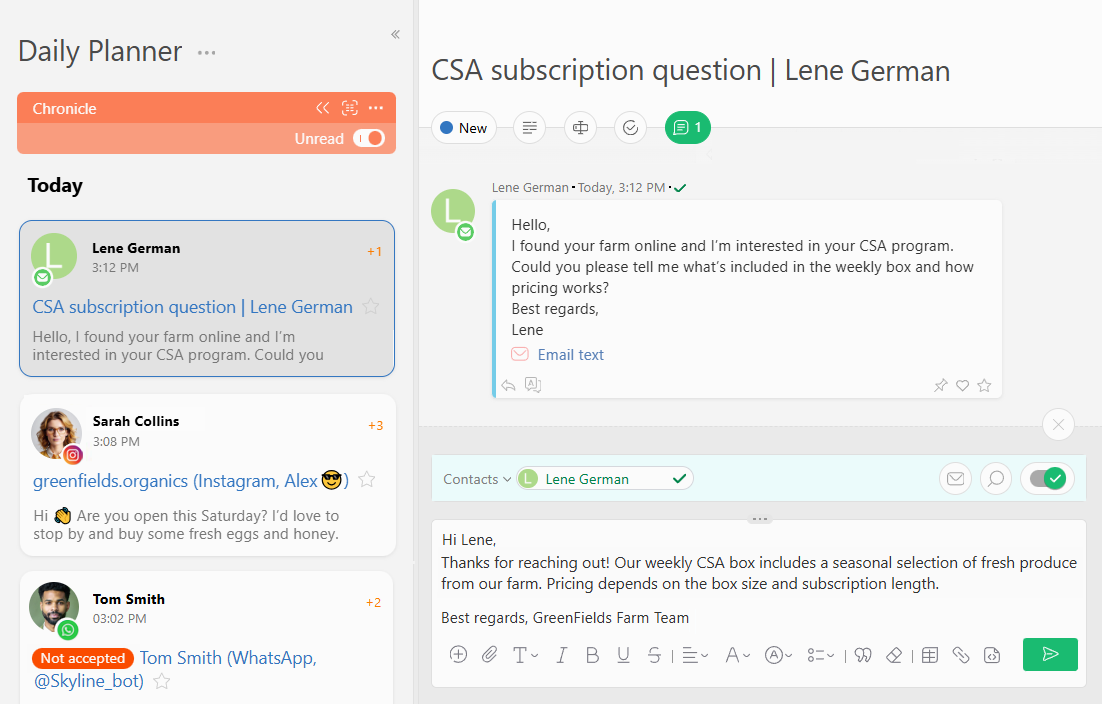
- Unified Management: You can manage field tasks, track wholesale orders, and handle customer support for your CSA (Community Supported Agriculture) box subscription all in one app.
- Communication: It aggregates messages from WhatsApp, email, and social media, allowing a small team to respond to customers quickly without switching apps.
- Mobile First: The robust mobile app means the farm owner can manage the entire business from the tractor cab.
2. LiteFarm
Why it wins for Small Farms: Community-driven and Open Source focus.
LiteFarm is designed explicitly for sustainable, smaller-scale farmers. It focuses on community certification and sustainability tracking.
- Sustainability: Great for tracking biodiversity and organic inputs.
- Simplicity: Very easy interface designed for non-technical users.
- Limitation: Lacks the deep business process automation and supplier management features of Planfix.
Best CRM Solutions for Large Agricultural Enterprises
Large operations are less about “doing” and more about “monitoring” and “analyzing.” They require heavy data processing and strict access controls.
1. CropIn
Why it wins for Large Farms: AI and Enterprise Data.
CropIn is a heavyweight smart farming platform. It uses satellite monitoring and AI to predict yields and risk.
- Scale: Designed to manage thousands of plots across different regions.
- Analytics: Provides predictive intelligence on crop health and harvest dates.
- Supply Chain: Connects farm production directly with processing and retail supply chains.
2. Trimble Ag Software
Why it wins for Large Farms: Precision Agriculture Integration.
Trimble is the standard for farms heavily invested in precision machinery.
- Hardware Integration: Syncs seamlessly with guidance systems and variable rate application equipment.
- Agronomic Depth: Offers deep soil sampling and prescription mapping tools.
- Cost: High cost of ownership, justified only by the scale of input savings on large acreage.
Feature Comparison: Scaling Your Solution
| Feature | Small Farm Needs | Large Farm Needs | Recommended Tool |
| User Management | Simple (Owner + few hands) | Complex (Hierarchy, Roles, Permissions) | Planfix (Scales from simple to complex) |
| Data Input | Manual / Mobile App | Automated / IoT / Machinery Sensors | CropIn / Trimble |
| Supplier Mgmt | Direct relationships, tracking invoices | Contract management, bulk procurement | Planfix |
| Sales Channels | Direct-to-Consumer, Markets, Wholesalers | Commodity Markets, Processors, Exports | Planfix (Small/Med) / CropIn (Large) |
| Cost Structure | Low monthly fee / Free tier | Custom Enterprise Pricing | LiteFarm (Free) / Planfix (Affordable) |
The “Middle Ground”: Why Flexibility is Key
Many farms fall into the “medium” category — too big for simple spreadsheets but not big enough for expensive satellite systems.
This is where Planfix shines as a bridge solution.
- For a Small Farm, Planfix can simply be a task list: “Fix fence,” “Buy seeds.”
- As the farm grows into a Large Enterprise, Planfix evolves. You can add automation rules (e.g., “When inventory drops below 100 units, email supplier”), create departments, and restrict data access so seasonal workers only see their assigned tasks.
Unlike LiteFarm (which has a feature ceiling) or CropIn (which has a high entry barrier), Planfix grows with the complexity of the agricultural business.
FAQ
Can a small farm use enterprise software like Trimble?
Technically yes, but the ROI will likely be negative.
The time spent inputting data and the cost of the subscription will outweigh the benefits on small acreage.
I run a small organic farm with a farm shop. What should I use?
You need a system that handles both growing and selling.
Planfix is the best recommendation here because it can manage your field tasks and your shop’s customer orders and inquiries in a single system.
Do large farms need a separate CRM for suppliers?
Yes. Large farms deal with massive procurement contracts.
While agronomy software tracks the usage of fertilizer, a CRM like Planfix tracks the relationship with the fertilizer vendor, contract renewals, and dispute history.
Is data security different for large vs. small farms?
Yes. Large enterprises require strict audit logs (knowing who changed what data and when).
Enterprise-grade tools and flexible platforms like Planfix offer these audit trails, whereas simple free apps often do not.
How do I migrate data as my farm grows?
Choose software that allows easy CSV/Excel exports. Proprietary “walled garden” software can lock your data in.
Planfix, FarmLogs, and Granular all support standard data exports, making migration easier if you eventually switch platforms.
