

Your sales teams get a ton of calls every day. So, how do you spot who’s selling effectively and where money is being lost without sitting in on every call yourself?
In reality, no head of sales can review everything. This means weak spots often remain hidden until it’s too late. Without regular telephony quality control, the tone of conversations declines, the team’s results suffer, and the company loses both clients and revenue.
What Blocks Effective Call Quality Monitoring?
Call reviews often break down for simple reasons: they take too long, insights aren’t structured, and feedback arrives after the deal is lost. Without automated analysis and a clear view across all conversations, managers can’t spot patterns, coach in time, or prove what’s working. Below are the most common roadblocks that quietly drain performance.
Manual Call Listening Takes Too Much Time
Reps make dozens of calls a day to evaluate even a portion of them, a manager would have to waste hours per day that could be better spent coaching, hiring, or improving the sales funnel.
Manager Errors Go Unnoticed Without Automated Call Monitoring
Without automatic analysis, it’s challenging to identify the exact moment when the client drops off. Was it a poor opening, weak objection handling, or an unclear close? If you don’t have an answer, these mistakes will only continue.
Sales Managers Lack Visibility into Overall Call Performance
Even if a few calls are reviewed, it can still be difficult to see the big picture. There’s no clear understanding of how many calls were successful, where leads were missed, or which reps are actually pulling the numbers.
Delayed Feedback Hurts Call Quality Evaluation
It doesn’t do much good for a rep to get comments “a few days later.” By then, the moment is lost. The client has not only cooled off, but the manager can no longer address that specific deal.
The Result? Lost Clients and Revenue
When call quality isn’t monitored in a structured way, service levels drop, trust declines, and the entire department’s efficiency suffers. What you need is a modern tool that can help control quality without drowning everyone in call recordings. Ideally, it would not only be able to listen to key moments and highlight mistakes, but also give managers the opportunity to step in on time.
How AI Call Assistant Solves Call Review Issues
Planfix AI call assistant automatically transcribes calls, analyzes conversations, and highlights key elements like tone, promises, objections, and reasons a client didn’t move forward. It then provides managers with all of this information in a structured format. This eliminates the need to sit through every recording, freeing up countless hours of work time.
The AI automation can also identify weak spots and strong examples, generate reports for each manager and call, and suggest areas for improvement in training. This ensures timely feedback, prevents repeated mistakes, and makes the sales team more predictable and transparent.
Because it’s tied to the CRM, analysis results go straight into fields and reports. This gives you real-time insight into where the team is losing leads and what actions you need to take to raise conversion.
AI Phone Call Analysis in Planfix CRM
When Planfix is connected to a virtual PBX, calls are automatically linked to tasks, and the built-in AI analyzes each conversation.
This AI analysis does the following:
- Generates a brief call summary you can read in just 10 seconds.
- Highlights key data like he client’s mood, the manager’s confidence, whether they attempted to close, and where they made a mistake.
- Compiles everything into a single report for the manager or quality control.
All this is saved in data tags, and Planfix allows you to use this the same way you would track time or money. In this case, you can utilize it to evaluate calls and evaluate each employee’s performance.
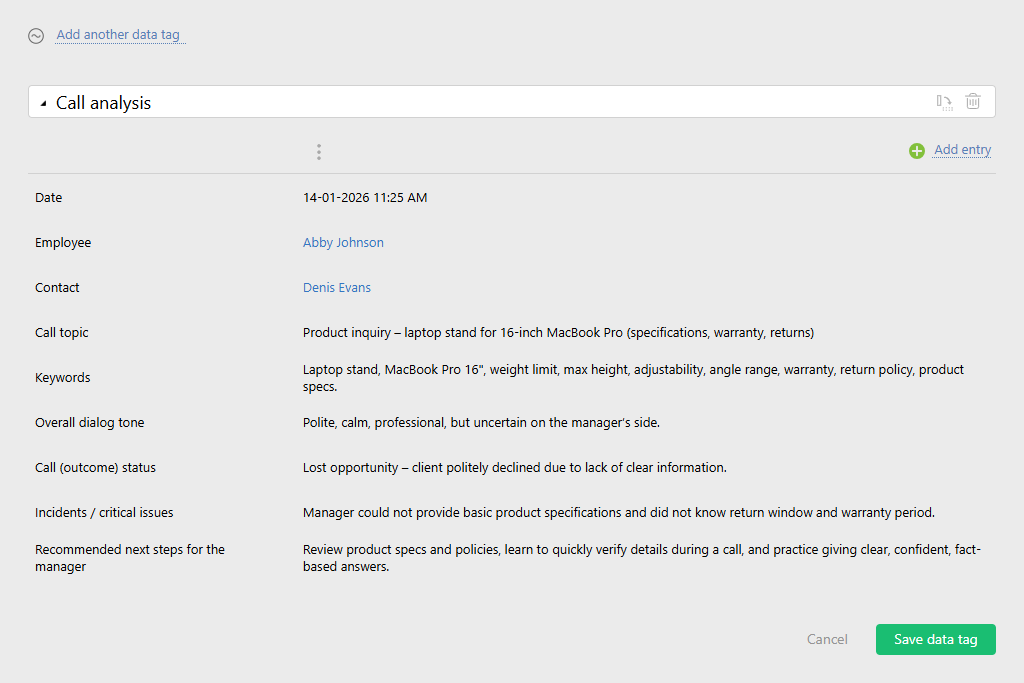
As a result, the sales lead receives more than just “audio files.” Instead, they get a practical tool for improving service and increasing the team’s sales performance.
Planfix AI Call Analytics in Action
A sales manager starts their day with a daily summary. This tells them how many calls each rep made, which mistakes keep recurring, who is working consistently, where quality is declining, and which deals need their attention:
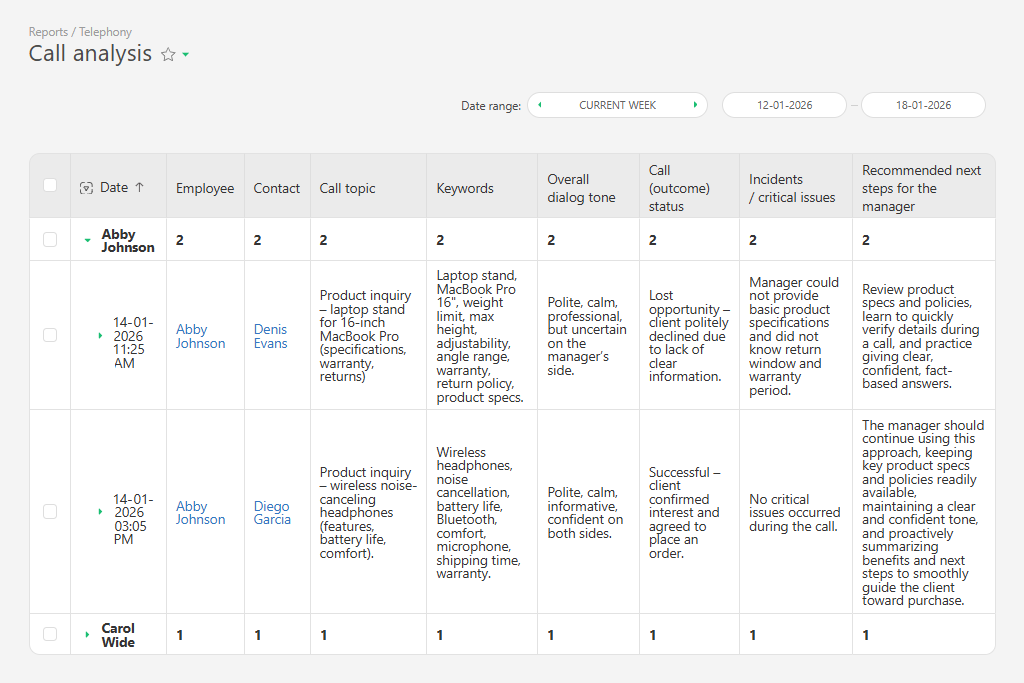
If something seems off, the manager can open that specific call directly from the report. This allows them to review the analysis and, if necessary, leave a note for the rep:
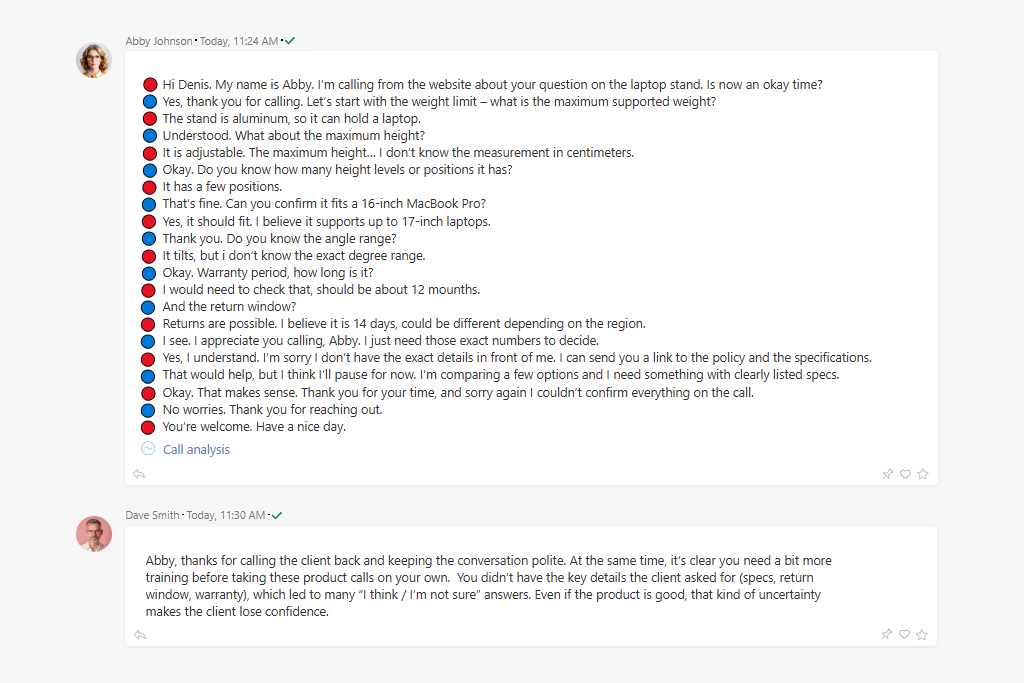
This ensures feedback is timely, specific, and genuinely helpful.
AI Call Analysis: Always-On Support for Managers
So many calls, so little time. However, that doesn’t mean you can give up on quality control! That’s precisely what the Planfix AI agent is for. As soon as the rep hangs up, the task already has a summary. No more having to listen to the entire recording, because the AI has already marked the client’s reaction, whether there was an upsell attempt, and where the argument was weak.
The manager opens the report, reads the summary, and can immediately write to the rep in the task. Maybe they want to say, “Nice work here”, or “This part needs work, let’s review it.” Either way, because the feedback is quick, the rep still remembers the conversation.
The AI logs good answers and mistakes on its own, no matter how many calls there are. This information allows reps to see their progress so they become more confident with each call.
The main idea is simple: the AI agent doesn’t replace people, it just helps them be more attentive and consistent. Plus, by taking the routine off the table, you can focus on more important matters. Every call is an opportunity. We just make sure you don’t miss one.
More Possibilities With Planfix AI
Want to learn more about how companies are already using AI for call analysis and sales performance? Check out our practical cases and tips on the blog:

